Stumped
Our boreal forest holds untold stories full of magic, science, and adventure. Stumped guides Botanical Garden guests though a Story Forest, where they will happen upon portals to the world of stories, transforming ordinary trails into magical literary waypoints. These pieces blend outdoor learning, imagination, and the restorative calm of the forest.
The stumps represent stories, whether from literature or the artist's own adventures, that include a blend of nature and the flora of our province. Viewers are encouraged to envision and experience nature in a novel way.
Art pieces may be impressionistic, realistic, abstract, textile, mixed media, paint- basically any media that allowed the artist to tell their story and vision of the world of plants, and the artistic inspiration found in nature.
Artist: Luca Jesse Apel
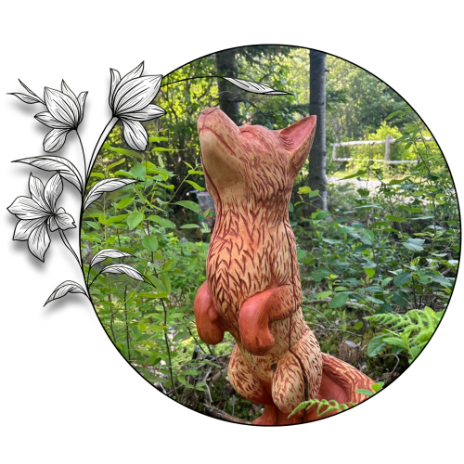 "In this stump, I have depicted the fox from Aesop’s classic parable, the Fox and the Grapes. In the tale, a young fox attempts to get to some grapes out of his reach before giving up and declaring them “probably sour anyway”. The moral of the story is that people sometimes scorn and despise the things they cannot achieve to avoid confronting their own limitations.
I have carved this stump of maple into a juvenile red fox – native to our province – standing on his hind legs to reach some high-hanging fruit. However, instead of grapes, I’ve paid homage to our province’s abundance of edible fruits and berries and titled it “The Fox and the Berries.” "
Luca Jesse Apel is a sculptor, installation artist, and lifelong nomad, creating works inspired by physiology and his Polish heritage. He works primarily with scavenged and off-cut wood—from logging operations, construction clearing, and naturally felled trees. Rather than imposing predetermined forms, he collaborates with the wood's imperfections: knots, cracks, and termite trails inform his designs, allowing each piece to dictate its final form. This dialogue with the medium is an integral part of his artistic process and draws parallels between wood and the human body in concepts of scarring, resilience, growth, and decay. Just as each piece of salvaged wood tells a story through its grain patterns, knots, and weathering, human tissues too reveal narratives of survival, adaptation, and healing.
Artist: Émile Sopkowe
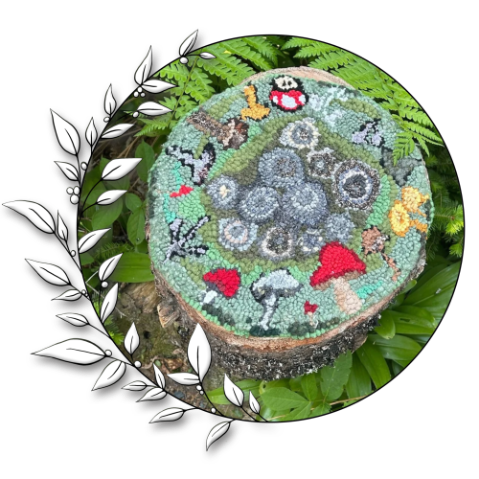
Hooked rug on burlap, mixed textiles.
This hooked piece was crafted by hand using traditional methods and repurposed textile material, cut into “worms” for hooking. Fairy Ring Stump is inspired by the forest floor of Newfoundland, crafted with repurposed cotton and wool materials. It is fitting that the mushrooms and lichen that appear on this stump-seat cushion are frequently tread or sat upon by people walking in the woods, unremarked upon, much like the hooked rugs that graced the floors of people's homes in days gone by.
Appearing in this hooked piece are many mushrooms and lichen common to Newfoundland, arranged in a fairy ring formation, plus one unnatural imposter: see if you can spot it!
"In an age of disposable fashion and cheap textiles, I repurpose materials that were created to clothe people in functional or fashionable garb, to create more enduring works of art.
Traditional hooked rugs are an art form borne of necessity, and they sprang from the need to economize and a culture that valued wasting nothing. While my hooked rugs often incorporate natural themes and imagery, I also seek to combine the warmth and comfort of a hooked piece with themes and imagery that step outside of traditional hooked rug imagery and patterns."
Artist: Jill Moores
 Jill has created an interactive stump that depicts organisms in a boreal forest food chain and also demonstrates different techniques and movements in art. She hopes that people interact with each other using the stump as a catalyst for discussion.
Jill Moores is a visual artist/art educator who is inspired by the NL landscape. She loves exploring elements of the seaside and forests while using both watercolour and acrylic paints.
Artist: Holli Corbett

My stump was inspired by the findings of Peter Wohelleben in his book The Hidden Life of Trees. Wohelleben sheds beautiful light on the connection that trees have to one another - comparing them to a human family. Trees care for, feed and support one another, even if (often especially if) one has been damaged, made ill, or cut down. As long as the roots are still connected to the ground, the other trees will continue to supply sugars to the stump, keeping it a living, connected being in the family. They warn one another of pests, and their mycelium stays interlaced beneath the ground, keeping them connected for their lifetimes. No tree stands alone.
Like trees, humans are connected too. We build families and weave our lives together. Sometimes it’s the one we are born into, sometimes we create one ourselves, sometimes it’s both. No one person stands alone. We are all connected. We can’t see the mycelium under the ground - nor can we see the web of love that connects us. But it’s there.
My stump is woven with coloured thread to show this connection. It’s not patterned. It’s messy. Some strings overlap, some weave through others, some veer away and then return. Much like our relationships and sometimes our love. It can be messy, it can ebb and flow. It’s not perfect, but it’s there. We are all connected. You are not alone.
Artist: Shokouh Abbaszadeh Movaghar

Long ago, the forests of Newfoundland were said to be protected by ancient forestguardians, mystical beings who revealed themselves only to those with kind hearts and a deep respect for nature.
When an old tree reaches the end of its life, its spirit does not disappear. Instead, it awakens a guardian from within the wood. Born from the forest itself, she carries the antlers of the woodland deer, the wisdom of the ancient trees, and the quiet magic of the land. She watches over every bird, every animal, every wildflower, and every traveler who walks the trail. The leaves woven into her antlers bloom with the changing seasons, reminding the forest that life is always renewing itself.
It is said that if you pause for a moment and meet her gaze, she offers a silent blessing, good fortune for your journey and a promise that the spirit of the forest will always walk beside you.
"This artwork is created with acrylic paint on a natural tree stump, transforming a fallen tree into a new expression of life and imagination. Rather than seeing the stump as the end of a tree's journey, I chose to see it as the beginning of a new story.
The figure represents a mystical guardian of the boreal forest. She is a magical being born from the spirit of the woodland. With antlers inspired by Newfoundland's native deer and leaves growing from them, she symbolizes the connection between people, wildlife, and the forest.
Her presence reflects the quiet strength of nature and the hidden magic believed to exist within ancient woods. The natural texture, shape, and history of the tree stump are an essential part of the artwork. Instead of hiding its imperfections, I embraced them and allowed the wood itself to become part of the guardian's story. The stump carries the memory of the tree, while the painting gives it a renewed purpose.
Through this work, I hope to encourage viewers to pause, imagine, and reconnect with the natural world. Guardian of the Boreal Forest reminds us that every fallen tree, every forest path, and every quiet place may still hold a story and perhaps a little magic for those willing to look closely."
Artist: Rolayne Lewis-Bartlett

The storyline and illustrations are based on the original story of Alice in Wonderland
"The classic story of ‘Alice in Wonderland’ by Lewis Carroll has delighted children and adults alike since it was published in 1865 and always a favorite of mine as a child. Before the days of iPads, computer games, and cell phones, as children we played outdoors every day, wandering into the wooded area close to home, building secret hideaways, chasing butterflies and bumblebees, looking for strange creatures living in the woods. Perhaps this explains the appeal of the story then and now. I can't imagine a more fitting adventure for children and adults alike than to experience the adventures of Alice in Wonderland. A classic story of imagination and wonder, as Alice follows the white rabbit with a pocket watch through the forest and down the rabbit hole. And what adventures await her!
My wish for visitors who happen upon the stump, nestled in the woods, is to peer down the rabbit hole and imagine what awaits Alice who has followed the white rabbit through the forest and into the rabbit hole where she falls down, down, down into an imaginary land of wonder and delight. Perhaps they will be inspired to seek their own adventures!"
Rolayne is a visual artist currently living in Mt. Pearl, NL who has always loved to draw and paint. As a multi-disciplinary artist, she works primarily in oil & acrylic, as well as other mediums including watercolors, pen & ink. Always eager to learn new techniques, styles and mediums, she has studied with many local and international artists. Drawing inspiration from everything and everyone around her, the moments in time - there is always a visual story to tell. Whether urban landscape or snapshots of everyday life, she simply paints what speaks to her. Rolayne is a member of, and has exhibited with, local art groups including Botanical Art Society of NL, Nightwatch Painting Group, Group of 77, Kathleen Knowling's Sunday Painters, Art Around the Bay, Art Bonavista and the Art Association of NL.
In 2020, she received the Provincial Arts & Letters Award in the Senior Visual Art Division, and has many works in private collections.
Artist: Glynn Bishop

Ted Rosales was the person who bought, planted, and pruned this tree meticulously, every year, for 45 years. When he passed away, I cut it, and a second tree, down for his wife. She was heartbroken to have to do it but it was too big and, in the winter, the snow would block her door. I promised I would make something with the wood. The stump is from one of the two trees: the Dwarf Alberta Spruce.
Russula mushrooms of our local boreal forest are ectomycorrhizal and have a symbiotic relationship with trees and shrubs where they trade nutrients for sugars. The mycelium in the soil and roots inform the plants of toxins and chemicals present, and work to remediate the soil environment. The mushroom is a reproductive fruiting body sent up from the mycelium below to release their spores in order to find another growing site. Mycelium may lay dormant for years before obtaining enough nutrients to produce the mushrooms, so finding a flush of delicious edible Russula mushrooms is luck indeed; however, not all of the Russula mushrooms are edible. Some of these mushrooms are toxic so be sure to have a correct identification before eating.
"I love to create. Pencil and paper, brush and paint, hand and clay, chisel and wood or stone, grinder and metal, and whatever else is usable to manifest what is in my mind. Nature is the source of inspiration, and spirit is the motivation. The cultural heritage of Newfoundland is strong in my intentions. To make something that is necessary for survival from random supplies is a gift passed on from my ancestors. I have learned deep compassion for those who have missed joy in their lives and seek to bring a smile to their face, or a gaze of wonder sometimes. Life is to be experienced, not viewed from a distance."
Artist: Molly Margaret

"My piece imagines the forest as a place of quiet wonder, where curious creatures wander together in harmony beneath canopies of moss, mushrooms, and native flora. Hidden among the trees, viewers may discover small faeries tucked into the landscape — tiny guardians of the forest whose stories are known only to the woods themselves. Inspired by the magic and restorative calm of Newfoundland and Labrador’s forests, the work invites guests to slow down, look closely, and imagine the unseen worlds that exist alongside our own."
Molly Margaret is an illustrator and muralist from St. John’s, Newfoundland, with a Bachelor of Design in Illustration from OCAD University in Toronto (2018). Inspired by plants, East Coast landscapes and culture, she creates colourful, whimsical artwork that celebrates the magic hidden in everyday moments. Whether she’s painting a mural, illustrating a story, or dreaming up a new project, Molly’s work is rooted in curiosity, joy, and a love of making spaces feel a little brighter. Her hope is to create artwork that sparks wonder, invites connection, and brings a smile to people of all ages!
Artist: Shawn O'Hagan
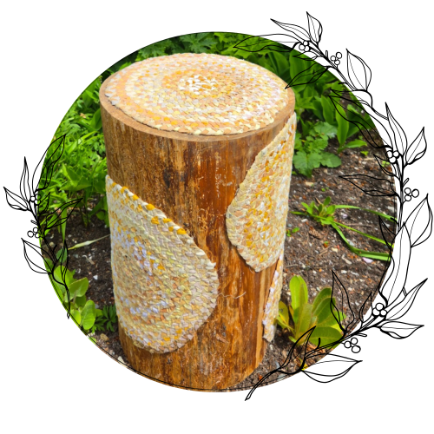 My recent work is about our symbiotic relationship with plants. Plants that give us air to breathe, food to nourish us and beauty to inspire us. Plants that sustain our planet at this most critical time. From 2023-25 I collected over 200 plants from my home on the west coast of the province. Spring, summer, fall, winter. And different parts of the plants – roots, leaves, flowers, seeds. I used what I gathered to dye organic linen and have made many works of art incorporating the linen including “song” ( 200, 20” squares of naturally dyed linen) and “what the land is telling me now” (40 small 3d pieces that each begin with a log for a base with the addition of braided or corded strips of linen as well as other gathered natural materials). In this careful study, nature has taught me of its knowledge, of its patience, of its predictable, cyclical journey. This is Nature's Story.
"My recent work is about our symbiotic relationship with plants. About our shared DNA. With increased urbanization and globalization, and with our busy lives, we have become more distanced from the plants that give us air to breathe, food to nourish us and beauty to inspire us. Plants that sustain us at this most critical time. My work is made through the use of material specific to the ecosystem ( linen, organic cotton, natural dyes from local plants, repurposed clothing) and a practice ( natural dyeing, repurposed clothing, and slow stitching) based in environmental awareness and anchored in the specificities of place). It is about my search for a connection to place, both in my actual home of Newfoundland and in my ancestral home of Scotland."
Artist: Jenna Catherine Johnson

Some of my favorite childhood memories were made on Blueberry Hill, a quiet hill behind my grandparents’ house in Botwood, Newfoundland. Every summer, we would climb the familiar hill together, carrying empty buckets, returning home with stained fingers, full pails, and stories shared between handfuls of berries. It was never just about picking blueberries; it was about spending time together, slowing down,and learning to appreciate the land that surrounded us. My grandfather passed away two years ago in August, but those afternoons remain some of the clearest memories I have of him.
This painting is my way of preserving one of those moments. Rather than recreating a specific photograph, I chose to paint the memory as it lives in my mind: warm, peaceful, and softened by Time. The wild blueberry plants that frame the piece are more than a native Newfoundland species; they are a symbol of place, tradition, and family. They guide the viewer into the landscape while reminding us how deeply our memories can become rooted in the plants and places we return to throughout our lives. This work celebrates both Newfoundland's natural beauty and the quiet traditions that connect generations. It is a tribute to my grandfather, to Blueberry Hill, and to the enduring power of memory carried through the landscapes we call home.
"My passion emerges from building dreamy landscapes through memories and instinct. When I explore the stunning scenery of Newfoundland, I constantly find myself deconstructing the beautiful views into the layers, values, brushstrokes, and textures that create them, mentally preparing myself long before entering my studio. Using acrylics, I paint Newfoundland not as a collection of places, but as a collection of moments experienced through its native landscapes. By framing familiar scenes with the province's indigenous plants, I invite viewers to see the land through a portal of memory, tying together the ecology and culture of this breathtaking island. Through each painting, I hope to encourage others to slow down, reconnect with nature, and discover the quiet beauty woven into Newfoundland's landscapes."
Artist: Wayne Maloney & Tina White

Artists Wayne Maloney (Bay Bulls) and Tina White (LaManche) have both found inspiration in nature and local culture. Their fairy paths crossed ten years ago on the East Coast Trail, it would be several years before they realized both were creating Fairy inspired art. When this call came out it was a perfect fit for the pair to collaborate on a Fairy inspired project!
Wayne would draw upon the fairy stories shared by his Grandmother Queen Maloney, while Tina found inspiration in a poem written in 1939 by a local grade three student, as well as leading hundreds of Fairy Door Tours over the past decade.
In the woods the fairies stray,
Softly at the close of day;
Oh, how lovely it would be
If those fairies we could see!
The woods are full of fairies, happy, bright and gay;
They play around like boys and girls, who have a holiday.
They dance and sing and make a ring around a fairy throne;
And on it sits the Fairy Queen,
The fairest ever known.
-RomaButler, Grade III. (1939)
Artists Tina & Wayne ask you to take a moment to…:
Sit in the moss, take a wee spell
Take in the bird song, breathe the tree smell
(Lower the draw bridge and peek inside!)
Artist: Melissa Francis

"Growing up in Newfoundland, I was always fascinated by stories of fairies hidden deep within the tuckamore, whistling or singing at dusk, trying to lure you into their mischievous little world. Over the years I've heard so many different versions of these stories, and I'm sure there are countless more waiting to be shared. To me, art is storytelling, and I don't think you can have one without the other. This little fairy world is a glimpse into that mystery and magic, a place that can exist forever... as long as we never lose our imagination."
Melissa M. Francis is a Mi’kmaw multidisciplinary visual artist from Gander Bay, Ktaqmkuk, and a member of Qalipu First Nation. She holds a Bachelor of Fine Arts (Visual Arts) from Emily Carr University in Vancouver, BC, and currently has over 20 public art pieces and permanent installations in communities across Canada. Living and practicing on the East Coast of Newfoundland, Melissa’s bold and colorful artwork is deeply inspired by her Indigenous culture and the striking landscapes of her homeland. Her practice explores themes of multicultural identity, community connection, and economic challenges, all while celebrating the strength of Indigenous perspectives and the resilience of Indigenous peoples.
For over a decade, Melissa has been active in mural arts, collaborating with artists from across Canada and beyond. She has participated in residencies, exhibitions, and workshops throughout Atlantic Canada, working with a variety of media including seed beads, acrylic paint, textiles, and sculpture, and is actively seeking opportunities to grow her practice through study, mentorship, and kin.
Artist: Brian Amadi
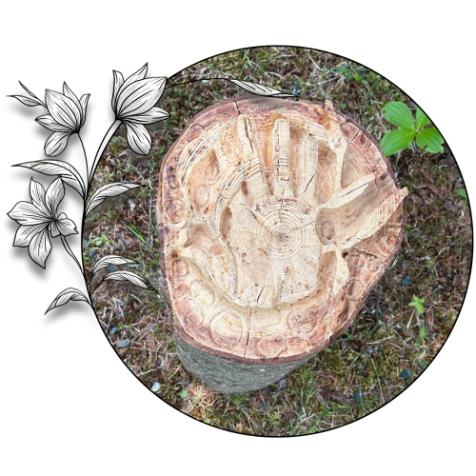
"For this piece, I travel back to my earliest memory with plants. I was 5 years old. The memory is a fleeting smoke in a bellowing wind punctuated by pain. I was on the way home from school, a 25-minute walk, very long for my little legs. That's why I walked with my siblings, who sometimes gave me a piggyback ride. When I wasn’t enjoying a free ride on a sibling train, I spent my time running my hand along tall, slender leaf grass that grew by the roadside (only just learned they were called Bracharia mutica). The smooth leaf curved and wrapped around my arms without conviction. Their touch was the tender massage of a makeup brush on my palm.
Sometimes, as they rustled and chittered from the wind, I would get so carried away that I would pluck one of the branches and then begin to strip it away. None of this was conscious. I remember it as a kind of drunken revelry, except there were no drinks, just the ecstasy of childish play. One day, I reached into the bunched-up grass to pluck one, and there was a judas. Another variation of the species with sharp serrated edges, not sharp enough to be a problem for most people who aren’t a 5-year-old with a devil-may-care attitude. But I was. It bit me. I screamed, knelt by the roadside, feeling betrayed, and cried. This was the first time I became aware of grass as a thing on its own, not just my toy. This was the beginning of my fascination with plants."
Brian Amadi is a multidisciplinary artist, filmmaker, and tattooist based in Newfoundland. With a background in political science, criminology, and public policy, Brian blends fine line tattooing, filmmaking, and painting to explore identity, belonging, and social structure. Art presents an opportunity to recall, play, and connect. His work has been exhibited locally and internationally, including at The Rooms, rOGUE Gallery, and the Canadian Embassy in Portugal.
A poet and advocate, Brian’s art bridges personal narrative with collective history, often using art as a tool for transformation, resistance, and social cohesion. For him, art is both a window and a mirror. Having lived in multiple places throughout his formative years, he is used to being a newcomer and therefore adjusting to or observing the social conventions and rules within the spaces he finds himself. Ultimately, he aims to use his work to reflect the current systems of social organisation he witnesses.
Artist: Lisa Locke

Created for STUMPED, this installation is inspired by Newfoundland's boreal forest and the weather-shaped trees that continue to leave their mark on the landscape long after they have fallen. Using weathered driftwood, exposed spruce roots, and a reclaimed stump, the work reflects the traces left by time, storms, and the changing seasons.
Rather than mourning what has been lost, it celebrates endurance, inviting visitors to consider the quiet stories still held within the forest.
Lisa Locke is a Newfoundland mixed-media artist inspired by the province's boreal forests and rugged coastlines. Through painting, textiles, sculpture, and natural materials, her work explores memory, resilience, and the quiet stories held within the landscape.
Artist: Michelle Dooley-Kirby
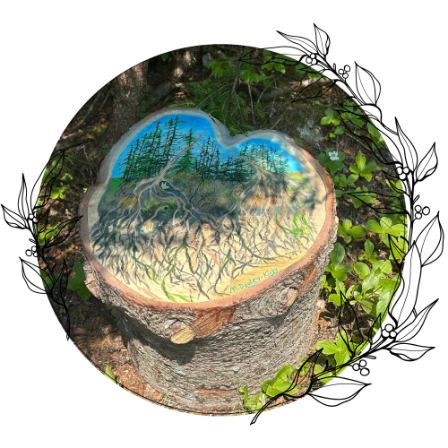
"When considering how to express my interpretation of the "Boreal Forest" and of Nature's recycling system (the process of the old feeding the new and fueling regrowth), my painting evolved from my original concept and expanded to include the way the trees, plants, and animals are so dependent on each other and everything is interconnected. The older, unstable, or damaged trees fall and return to the earth for decomposition and its rich debris feeds and fuels new life whose roots take hold to their own claim on the earth. All are connected, and in the same life cycle. "Nature's rejuvenation""
Hello, my name is Michelle Dooley-Kirby and I am a Newfoundland artist who enjoys working in a variety of mixed media, including acrylics, watercolor and alcohol inks. My artwork is mostly inspired by what I see in nature’s whimsical vivid colors and the ever changing cycles of regrowth and movement. Trees and water are among my favorite subjects to paint, as they are ever changing and evolving. I find satisfaction in the creative process, even though it can be challenging at times. It is more often a joy to behold when it all comes together. My painting on an assigned “Stump” developed into so much more than I expected, and unveiled my proposed concept in a beautifully orchestrated dance with each brush stroke and layer. Nature’s palette inspires me to create; art inspires me to play. Together they are my perfect combination of expression and creativity.
Artist: Katie Vautour
Dedication: In memory of Wendi Smallwood - fantastic actor and patron of the arts

This stump depicts paintings of flora and fauna based on the popular Redwall series of books by Brian Jacques. These books center around the adventures of woodland creatures living in an abbey in a mossy forest, who embark on heroic battles and epic journeys. The paintings on the stump illustrate the magical world of Redwall through a Newfoundland lens, depicting wildlife and plants native to Newfoundland that are featured in these books.
The paintings feature four creatures that are key characters in the Redwall series and are also native to Newfoundland: a pine marten (the main villain), a meadow vole (a protagonist), and a little brown bat (companion to the protagonist). Redwall Abbey is home to a large apiary, so the design also features honeybees, which are a crucial feature of the Botanical Garden and the Newfoundland ecosystem as a whole.
The stump weaves the characters amongst plants grown in the botanical garden. The selected plants are either directly mentioned in the novels, or are likely to be encountered by the characters on their journeys across various landscapes. These include fiddleheads, or ostrich ferns, marsh marigolds, creeping juniper, and pitcher plants.
Katie Vautour is a visual artist and writer whose work explores humans' relationship to the natural world, and the creatures within it. Her artwork is on permanent display at the Salmonier Nature Park, and her book of poetry, An Unorthodox Guide to Wildlife, was published by Breakwater in 2019. Katie has participated in residencies in Oaxaca, Mexico and the Banff Centre. She has painted traffic boxes for the city of St. John's for over ten years, and participated in the Botanical Garden's 2024 Windows on the Garden exhibition.
Katie's art writing has featured in a variety of literary journals including Riddlefence, The Fiddlehead and Pulp Literature, as well as the Journal of Ocean Technology. Katie is an illustrator and writer for Newfoundland Quarterly and is currently producing feature artwork for the 125th anniversary of the journal.