In Principle:
Genetic Engineering involves the laboratory manipulation of DNA
What does a particular region of DNA do?
This may involve isolation & manipulation of a "gene of interest"
in vivo or in vitro "cloning" of the gene [Nobel Prize 1980]
analysis of the cloned gene
gel electrophoresis
nucleic acid "blotting"
DNA sequencing
mRNA expression
Genetic Engineering involves the laboratory manipulation of DNA
What does a particular region of DNA do?
This may involve isolation & manipulation of a "gene of interest"
in vivo or in vitro "cloning" of the gene [Nobel Prize 1980]
analysis of the cloned gene
gel electrophoresis
nucleic acid "blotting"
DNA sequencing
mRNA expression
DNA sequencing [Nobel Prize 1980]
Polymerase Chain Reaction (PCR) [Nobel Prize 1993]
fresh viral, prokaryotic, or eukaryotic (plant & animal, etc.) material
separation from protein & lipid with polar / non-polar solvents
"kit" methods rely on selective binding of DNA
Ancient DNA
museum specimens: 10s ~ 100s years
fossils: 1,000s ~ 1,000,000s years
Ex.: Magnolia fossil leaves at 18 MYBP
Ex.: insects in amber
Ex.: ancient humans: Neanderthals [IG1 21.23]
Oetzi the Iceman
Forensic DNA
Forensics: data used as evidence
Ex.: blood / semen stains at crime scenes
Ex.: What species do these fillets come from?
mRNA
 cDNA
cDNAIn vivo Molecular Cloning
Type-II restriction endonucleases
cut DNA only at specific restriction sites (list)
DNA palindrome -
"Able was I ere I saw Elba"
"Madam, I'm Adam"
"Straw? No! Too stupid a fad, I put soot on warts."
''Doc, note I dissent. A fast never prevents a fatness. I diet on cod."
restriction site reads the same in 5'
3' direction on both strands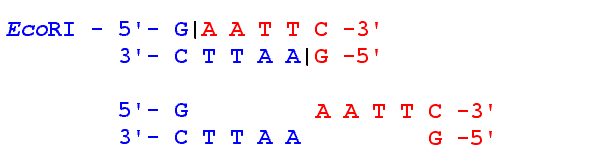
Overhanging TTAA-5' are "sticky ends"
Vector insertion
Vector - a means of moving DNA from one place to another
Plasmids - a circular, extrachromosomal DNA
"naked DNA", a "bacterial virus"
pUC18 - an artificial plasmid with:
polylinker containing multiple, unique restriction sites
selectable markers that tell you when plasmid is present
antibiotic resistant (e.g., tetracycline or ampicillin)
lacZ gene produces beta-galactosidase,
metabolizes Xgal sugar
 blue product
 lacZ gene includes polylinker
Recombinant DNA molecules are formed when
linearization of vector DNA by digestion with endonuclease
ligation of "sticky ends" between source DNA & vector DNA
combines DNA from two different sources [online animation]
In vivo Cloning in E. coli [IG1 02.18]
E. coli K12 strain
can't grow in presence of antibiotics (antibiotic-sensitive)
can't metabolize X-galactose (Xgal) sugars
Host transformation integrates plasmid DNA into bacterial chromosome
Bacteria acquires genetic traits of plasmid
Colony Selection Scheme: finding the rare bacterium with recombinant DNA
Only E. coli cells with resistant plasmids grow on antibiotic medium;
only plasmids with functional lacZ gene can metabolize Xgal
lacZ(+)
blue
colonies lacZ functional
polylinker intact nothing inserted, no clone lacZ(-)
white
colonies polylinker disrupted
successful
insertion & recombination
! Bulk bacterial culture of recombinant (white) colonies
Purify cloned plasmid DNA, cut cloned gene out with endonucleases:
Gene is ready for Analysis
SUMMARY OF pUC CLONING
Polymerase
Chain Reaction
In vitro DNA "cloning":
"DNA xeroxing": four components & one gadget
DNA template
anything with DNA in it
oligonucleotide primers ("oligos")
short (20 ~ 30 base) ssDNA complementary to gene
some knowledge of gene is required :
"Universal primers" work across many species
Taq DNA polymerase
heat-stable enzyme from hot-spring bacteria (Thermus aquaticus)
functional at 70 ~ 80oC, withstands exposure to 95oC
dNTPs: four building-blocks for DNA
Thermal cycler: computer-controlled heating & cooling block
temperature change > 1oC / sec
PCR doubles gene copy number each cycle
denature / anneal / extend: 2 4 8 16 32 64 etc.:
10 cycles = 210 = 103 copies, 20 cycles 106 copies,
30 cycles (~2 hrs) 109
copies
[ of PCR]
PCR process is completely automated
replicates specific gene only
makes sufficient quantities of purified genes for direct analysis
In vitro DNA "cloning":
"DNA xeroxing": four components & one gadget
DNA template
anything with DNA in it
oligonucleotide primers ("oligos")
short (20 ~ 30 base) ssDNA complementary to gene
some knowledge of gene is required :
"Universal primers" work across many species
Taq DNA polymerase
heat-stable enzyme from hot-spring bacteria (Thermus aquaticus)
functional at 70 ~ 80oC, withstands exposure to 95oC
dNTPs: four building-blocks for DNA
Thermal cycler: computer-controlled heating & cooling block
temperature change > 1oC / sec
PCR doubles gene copy number each cycle
denature / anneal / extend: 2
4 8 16 32 64 etc.: 10 cycles = 210 = 103 copies, 20 cycles
106 copies, 30 cycles (~2 hrs)
109
copies [ of PCR]
PCR process is completely automated
replicates specific gene only
makes sufficient quantities of purified genes for direct analysis
Restriction mapping
Determining the order of & distances among restriction sites in DNA fragment:
this provides an "outline" of the DNA sequence [IG1 21.22]
Gel electrophoresis separates DNA fragments by molecular weight
DNA is visible under Ultraviolet light with fluorescent dye
( of agarose gel electrophoresis)
Fragment sizes in single & pairwise restriction digestions compared:
order & distances among sites determined
( of Restriction Mapping logic)
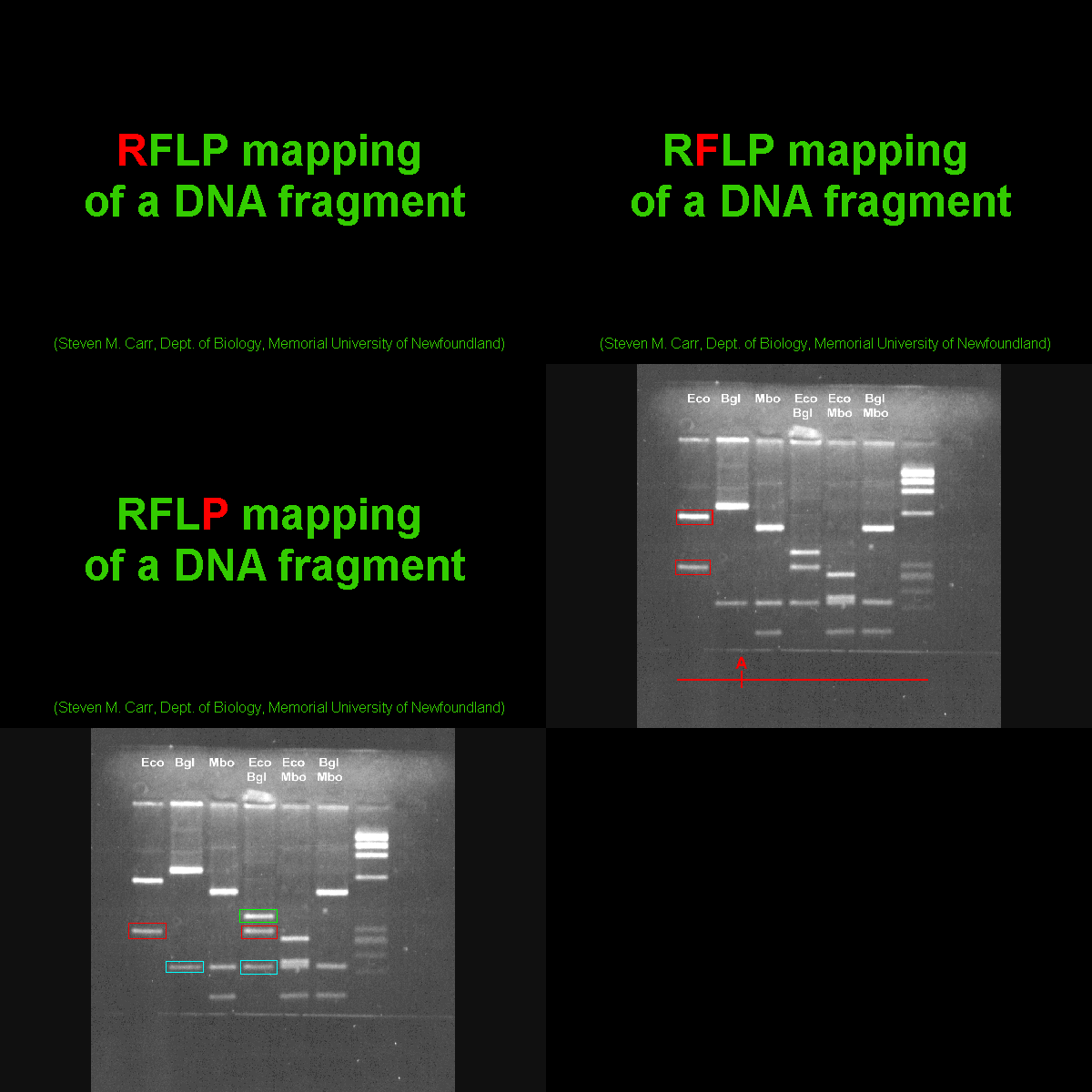
Restriction maps of overlapping fragments assembled as contig map
Southern Blot analysis
Useful when gene of interest is rare: one locus / genome
DNA is transferred ("blotted") to filter paper
Filter is exposed to a DNA probe
Probe: instrument or method that measures something: e.g., thermometer
ssDNA complementary to gene region of interest
~ same as primer / oligo in PCR experiment
Binds specifically to target DNA immobilized on filter
Radioactively labeled with 32P-dNTPs
exposes X-ray film Autoradiogram shows presence / absence & size of target DNA
RFLP differences
( of southern blotting)
DNA probe binds to RNA in gel: a "Northern Blot"
Is a particular gene (DNA) expressed as mRNA in a particular tissue?
[Antibody probe binds to protein: "Western Blot"]
DNA sequencing
in vitro DNA replication copies one strand repeatedly
cf PCR: both strands replicated
Provides complete order of bases in a DNA fragment
DNA primer is complementary to 3' end of gene of interest
dideoxynucleotide terminators (ddNTPs)
stop strand growth during replication
four separate reactions terminate at ddA, ddC, ddG, or ddT [IG1 02.19]
Sequencing gel shows series of partial DNA replications
Sequencing "ladder" autoradiogram is read from bottom to top
( of dideoxy DNA sequencing)
Automated DNA sequencers uses laser fluorometry
ddNTPs are attached to fluorescent dyes in a single reaction
scanning laser & fluorometer "see" fluorescence colours (A C G T)
computer "calls sequence" as a chromatogram [IG1 02.21]
( of automated DNA sequencing)
Next Generation sequencing uses massively-parallel, high-throughput methods [IG1 ResBrief 21.1, pp. 454-455]
NextGen sequencers use capillary separation [IG1 02.20]
Next-Generation Sequencing (NGS) - clinical applications
Files are in PC or Mac format & require the Shockwave viewer:
Click here to go to the download site
Homework Problems: MGA2 Chapter 8, pp. 259-260: ## 2, 3, 5, 6, 7, 13