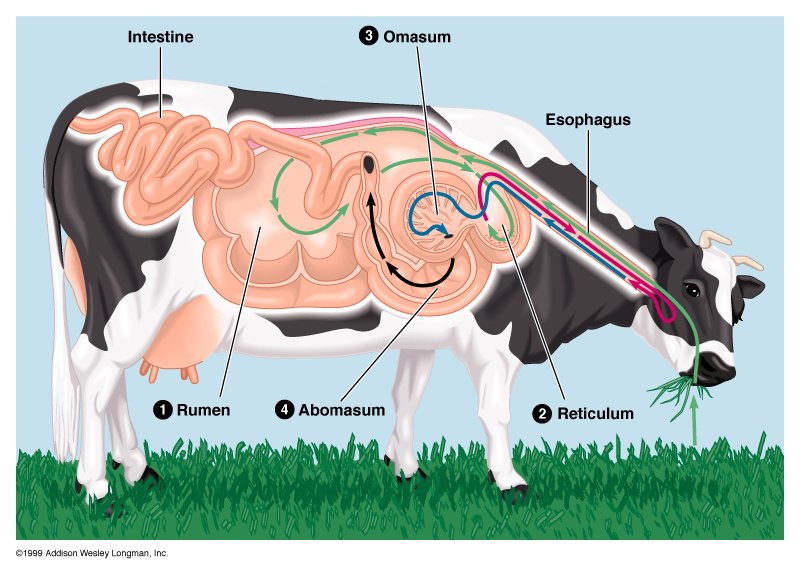
Ruminant digestion in
Bos
taurus
Like other
vertebrates, ruminant Artiodactyla
(including cattle, deer, and their relatives) are unable to
digest plant
material directly, because they lack enzymes to break down cellulose
in the cell walls. Digestion in ruminants occurs sequentially in a
four-chambered
stomach. Plant material is initially taken into the Rumen,
where
it is processed mechanically and exposed to bacteria than
can break down
cellulose (foregut fermentation).
The Reticulum allows the
animal to regurgitate & reprocess particulate matter ("chew
its
cud"). More finely-divided food is then passed to the Omasum,
for further mechanical processing. The mass is finally passed to
the true
stomach, the Abomassum, where the digestive enzyme lysozyme
breaks down the bacteria so as to release nutrients. Use
of plant material is thus indirect, with primary processing by the
bacterial flora maintained in the stomach.
The Perissodactyla (including
horses, rhinoceroses, and tapirs) have evolved a less efficient
form of ruminant digestion. Bacterial fermentation occurs
primarily in the intestine (hindgut
fermentation), such that extraction of nutrients
from plant material is less complete. [Compare horse droppings
with 'cow flops': the former contains more or less intact
plant material that may be scavenged by birds, whereas the latter
is essentially amorphous].
Although all mammals have lysozyme, the
enzymatic properties of ruminant lysozyme have evolved to be
especially
efficient. In a superb example of convergent
evolution,
some leaf-eating monkeys
have evolved a lysozyme with similar enzymatic
properties, due to selection on independent mutations to produce
identical amino acids at key active sites.
Figure © 1999
by Addison Wesley Longman Inc; All text material
© 2005 by Steven M. Carr