Nursing students throughout the province learn Indigenous perspectives on healthy aging
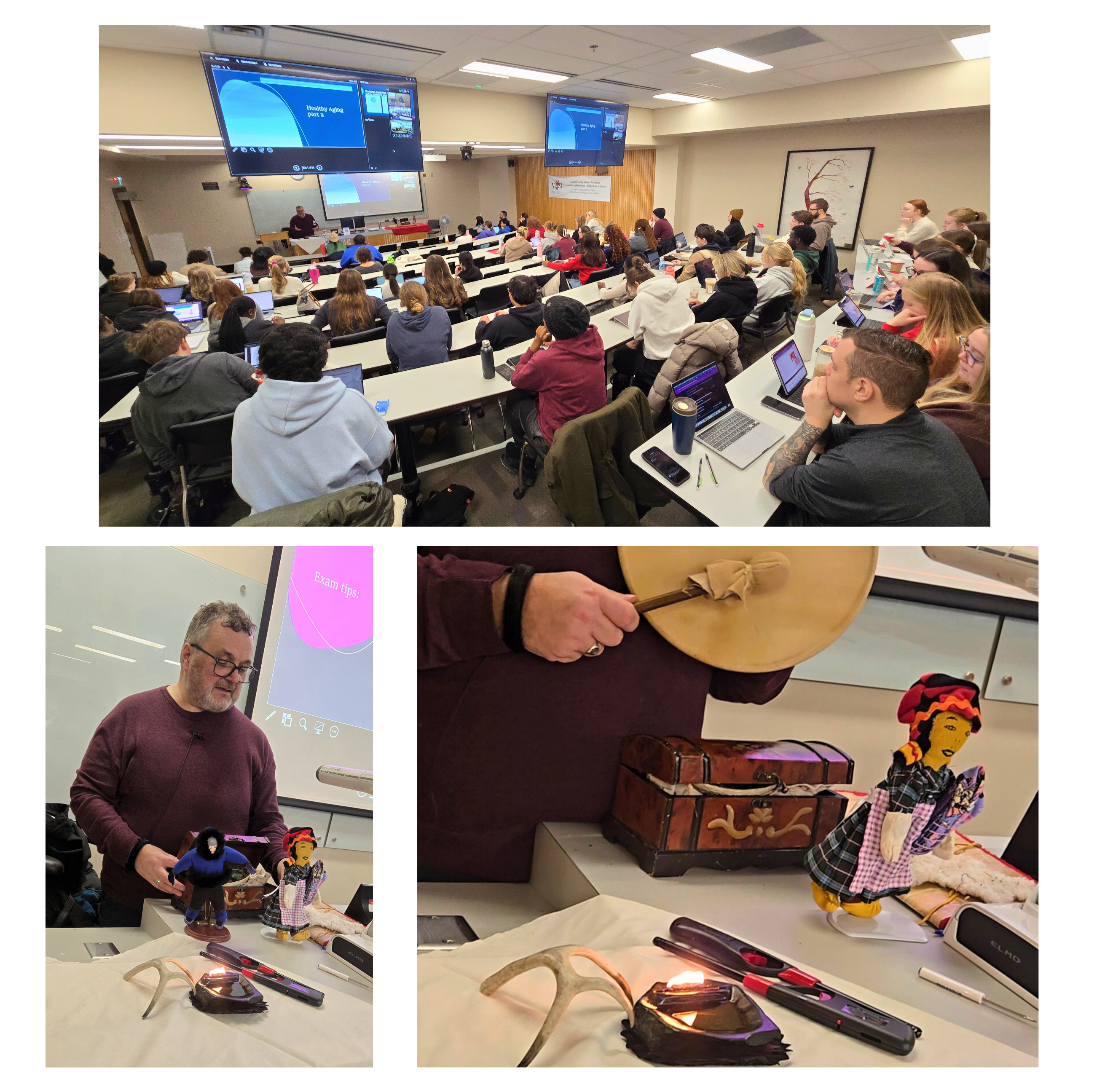
A traditional Qulliq flame flickers at the front of a first-year nursing classroom as Tom Mugford speaks on Indigenous perspectives of healthy aging — his words reaching students in St. John’s, Gander, Grand Falls–Windsor, and Happy Valley–Goose Bay.
The flame of a traditional Qulliq lamp flickered at the front of a first-year nursing classroom recently as Tom Mugford began his guest lecture.
The lecture was delivered to students in Dr. Hrag Yacoubian’s and Dr. Rebecca Puddester’s N1016: Caring for the Older Adult (Theory) class, presented in person at the St. John’s campus and streamed live to students in the satellite campuses in Gander, Grand Falls–Windsor, and Happy Valley–Goose Bay.
As Program Development Specialist for Indigenous Education (K–12) with the Government of Newfoundland and Labrador, Mr. Mugford opened the session by lighting the lamp before speaking to students about healthy aging through Indigenous and First Peoples’ perspectives.
A Beneficiary of the Labrador Inuit Land Claims Agreement, he has deep roots in Labrador, where he spent many years as a teacher, school administrator, and community leader before relocating to St. John’s.
“When our flame is dancing, it’s our ancestry coming to join us in our space today.” - Tom Mugford
Invited by Dr. Hrag Yacoubian, Mr. Mugford addressed topics including social determinants of health, rural and remote access to care, residential schools, and intergenerational trauma. He emphasized that his goal was not to place blame, but to prepare future nurses for practice.
“I don’t want this to be a session of guilt,” he said. “I want you to walk away… the most effective nurses and carers that you can be.”
Mr. Mugford encouraged students to look beyond clinical presentations and consider the histories and communities patients carry with them into healthcare settings.
“When you’re caring for a person, you need to know who they are. Their history. Their community. They’re more than what’s in front of you.”
He summarized the message in a line that resonated with the room: “Respect is a clinical intervention.”
During discussion about how this knowledge should shape future nursing practice, one student shared that the session left him feeling “informed” and “ready to change some of the ways we care.”
The lecture aligned with the faculty’s approach to strengths-based nursing, relational inquiry, and commitments to Indigenization and the Truth and Reconciliation Commission’s Call to Action #24, which calls on nursing schools to teach the history and impacts of Indigenous health.
“You won’t change the system overnight,” Mr. Mugford told students. “But you will be part of the system that makes positive change.”
He closed the session with practical guidance for students entering the profession: “Stay humble. Listen to understand. Be your best self.”
Mr. Mugford’s lecture served a call and reminder to continue the conversation in our ongoing journeys of listening, learning and unlearning in nursing to ensure a bright future for all.
Indigenous undergraduate nursing students in the province are invited to take part in a one-time storytelling interview (60–90 minutes, virtual or in person, individual or small group) exploring perspectives related to the Truth and Reconciliation Commission’s Calls to Action. Participants will receive a $10 gift card in appreciation of their time. Contact Sanaz Labbaf, Graduate Research Assistant: slabbaf@mun.ca. This research is led by Dr. Hrag Yacoubian (PI), Dr. Erica Hurley (PI), and Dr. Robin D. Burry.
Learn where you live.
Memorial University’s Bachelor of Science in Nursing (BScN) (Collaborative) program allows students to learn where they live through sites across Newfoundland and Labrador, including St. John’s (two locations), Corner Brook, Gander, Grand Falls-Windsor, and Happy Valley-Goose Bay.
The program combines remote classroom learning with local, in-person clinical and simulation experiences, enabling students to train close to home while receiving the same accredited nursing education across all sites.
More details: https://www.mun.ca/nursingadmissions/
Follow the Faculty of Nursing:


