Taking the reins
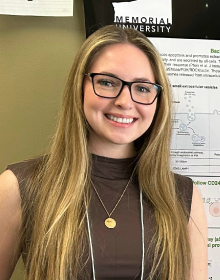
From teaching horseback riding to fast-tracking her way through a PhD, Kaitlyn Mayne has learned to trust her instincts, pursue what inspires her and take charge of where they lead.
Where are you from?
I'm from Hopeall, a small community on the Avalon Peninsula in Newfoundland.
What do you like about St. John’s or Newfoundland and Labrador?
I grew up here, so our unique culture is something I have always been super proud of. There’s a familiarity to it that makes this place feel like home. The thing I probably love the most is the ocean and our landscape and views.
What do you enjoy doing for fun?
In my free time, I enjoy spending time with my family and my dog Peaches, as well as horseback riding. I’m also a certified therapeutic riding coach, so some evenings you’ll find me teaching horseback riding lessons at Rainbow Riders.
Why did you decide to pursue a graduate degree and why did you choose Memorial?
My aunt did her PhD in Biochemistry at Memorial in the ’90s. She inspired me to study biochemistry and made me curious about what a career in research could look like. When I started my undergraduate degree at Memorial, I knew I wanted to do research, but I was still figuring out what area interested me most.
That changed when I did my honours project in Dr. Sherri Christian’s lab. I enjoyed the work so much that I asked if she would take me on as a master’s student. After my first year, I fast-tracked into the PhD program, and I’m now in my fourth year. I also want to build a career here in Newfoundland and Labrador, and studying at Memorial gave me a chance to get to know the research community in the province.
How would you describe your graduate student experience at Memorial?
One of my favourite parts of graduate school has been teaching. I’ve worked as a teaching assistant, received two departmental TA Excellence Awards and had the chance to guest lecture in undergraduate courses. I really enjoy teaching others about the things I am passionate about. One of the bigger challenges has been applying for research funding. These awards are competitive, and a lot of work goes into explaining what you want to study and why it matters. Going through that process helped me to become confident about my own research and better at explaining it to people outside my field. Receiving the $70,000 Doctoral Research Award from the Cancer Research Society, co-funded by the Leukemia & Lymphoma Society of Canada, was one of the highlights of my PhD.
Can you tell us a little about your research?
My work focuses on how B cells, a type of immune cell, communicate with one another. Cells can release tiny packages called extracellular vesicles, which carry information that other cells can receive. I’m looking at how B cells create these packages and whether the messages they send might help other cancer cells survive.
What drew me to this topic was the idea that understanding a cancer cell also means paying attention to the messages it sends out and how other cells respond. If we can figure out what these messages do and how they’re sent, we may eventually find new ways to interfere with the ones that help cancer cells survive.
What industry or career path are you interested in pursuing after graduation?
I’d like to stay connected to health research and build my career in Newfoundland and Labrador. I enjoy working with other people to turn a research question into a project, and I’d like a role that lets me do more of that. I’d also love to keep teaching or mentoring students in some capacity. That’s something I discovered I really enjoy during my PhD.
Do you have any advice for current/future graduate students?
If you’re curious about a lab or a research topic, reach out and ask about it. Doing a MUCEP/ISWEP placement or an honours project is a really good starting point. My honours project gave me a chance to see what lab work was like day to day, and asking my supervisor about staying on as a master’s student is how I ended up here.
I’d also encourage students to ask about and apply for awards they’re eligible for, even when the competition feels intimidating. Give yourself time to write, and re-write! Ask others within your field and someone outside your field to read your proposal. It’s a good way to find out whether you’ve explained why the research matters as clearly as you think you have.
Anything else you would like to share?
I’d like to thank Dr. Sherri Christian and everyone in the Christian Lab who have supported me on my grad school journey!
Become a graduate student at Memorial. Apply online today!