
The patriot
John Lewis Paton, the first president of Memorial University College (MUC), believed that an educational institution should reflect the aspirations of the people it serves and should be woven into the very fabric of the community it calls home.
And perhaps no leader in Memorial University’s history championed Mr. Paton’s beliefs more than his former student at MUC, Dr. Moses Osbourne Morgan.
Born in Blaketown, Trinity Bay, in 1917, Dr. Morgan attended MUC and then went on to complete his undergraduate degree at Dalhousie University.
Although he was named the Newfoundland Rhodes Scholar for 1938, he delayed his graduate studies at Oxford until after the Second World War.
In 1942, he enlisted in the Canadian Army and saw service as a platoon commander in Europe.
He then completed his master’s degree at Dalhousie and moved on to study in England.
While at Oxford, he often travelled to Kemsing, Kent, to visit with his old mentor, Mr. Paton, who had since retired from MUC.
After completing his graduate work, Dr. Morgan retuned to Canada and taught at Dalhousie for two years before joining Memorial in 1950 just as the institution was redefining itself in the years following Confederation.
Almost as soon as he arrived, he became a part of a small group of people who would shape the future of our institution.
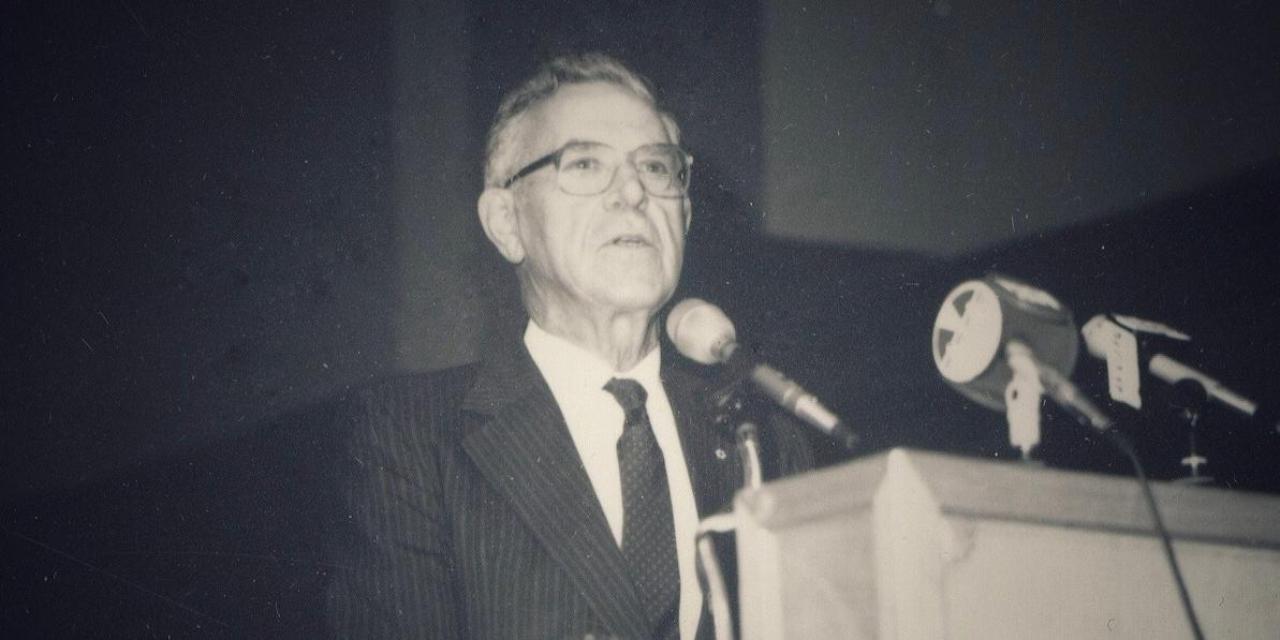
Dr. Morgan speaking at the opening of the School of Music Building in 1985. Photo from Memorial University Archives.
He became dean of the Department of Social Studies, then assistant dean of arts and science in the late 1950s. He was president (pro tempore) from 1966 to 1967 and president from 1973 to 1981.
Known publicly as a strategic and accomplished administrator, he also had an uncanny knack for finding the right people for the right job.
In 1961, he started the Institute for Social and Economic Research (ISER) at Memorial, and at the time, ISER was a revolution in socially relevant research with an initial focus entirely on the province.
Dr. Morgan was the driving force behind the creation of Junior Division, the groundbreaking unit comprised of experienced teachers working to help first-year students make a successful transition to university.
When Memorial decided to establish the Faculty of Engineering, Dr. Morgan found Dr. Angus Bruneau at the University of Waterloo, a move that led to the foundation of only the second co-op engineering program in Canada.
When the province needed doctors, nurses and social workers, Dr. Morgan helped start the Faculty of Medicine, the School of Nursing and the School of Social Work.
What is now known as Grenfell Campus was established during his presidency as was the Labrador Institute, which would later evolve to become our Labrador Campus.
Morgan went on to receive 8 honorary degrees from universities in Canada, largely due to his efforts with ISER, Extension and Junior Division, which were all revolutionary ideas in a post-secondary setting.
He was made a companion of the Order of Canada in 1973 and named president emeritus of Memorial University in 1983.
In 1994, Memorial celebrated his contributions again by awarding him an honorary degree.
Dr. Morgan died in 1995.
During his time with the university, he provided principled leadership during a period of rapid institutional growth.
But to list his many contributions as if they were separate or individual achievements would be to misunderstand the story of Dr. M.O. Morgan.
The community of adventurous minds that he helped build here, the campuses that appeared in other parts of the province, and all his accomplishments were a part of one project, one singular vision. And that vision was to serve the entire community, just as J.L. Paton had advised.
In many ways, Dr. Morgan was a patriot as much as he was a president. And his precedent continues to inform Memorial’s identity as Newfoundland and Labrador’s university. A university reaching out to the province it was created to serve.
 0019 2-370x493.jpg)
Dr. M.O. Morgan received an honorary degree from Memorial University in 1994. Photo from Memorial University Archives.