New budget model
Building Memorial’s Future Budget Model
Memorial is developing a new budget model to create a more transparent, consistent and sustainable approach to how resources are understood and allocated across the university.
This work is part of a multi-year process of design, testing, consultation and refinement toward planned implementation in 2028-29.
Our progress to date
(more details on the timeline can be found here)
| Milestone | Status |
|---|---|
| Alternative budget model approaches explored | ✓ Complete |
| Recommended approach identified | ✓ Complete |
| Initial phase governance and project structure established | ✓ Complete |
| Conceptual model developed | ✓ Complete |
| Proposed methodology applied to institutional data | ✓ Complete |
| Initial shadow results reviewed with senior leaders and governance groups | ✓ Complete |
| Consultation, validation and refinement with units | Underway |
| Community release of shadow results with supporting context | Winter Semester 2027 |
| Model refinement, transition planning, tools and training | 2027–28 |
| Planned implementation | 2028–29 |
Memorial is implementing an Activity Based/Responsibility Centre Management (ABB/RCM) budget model.
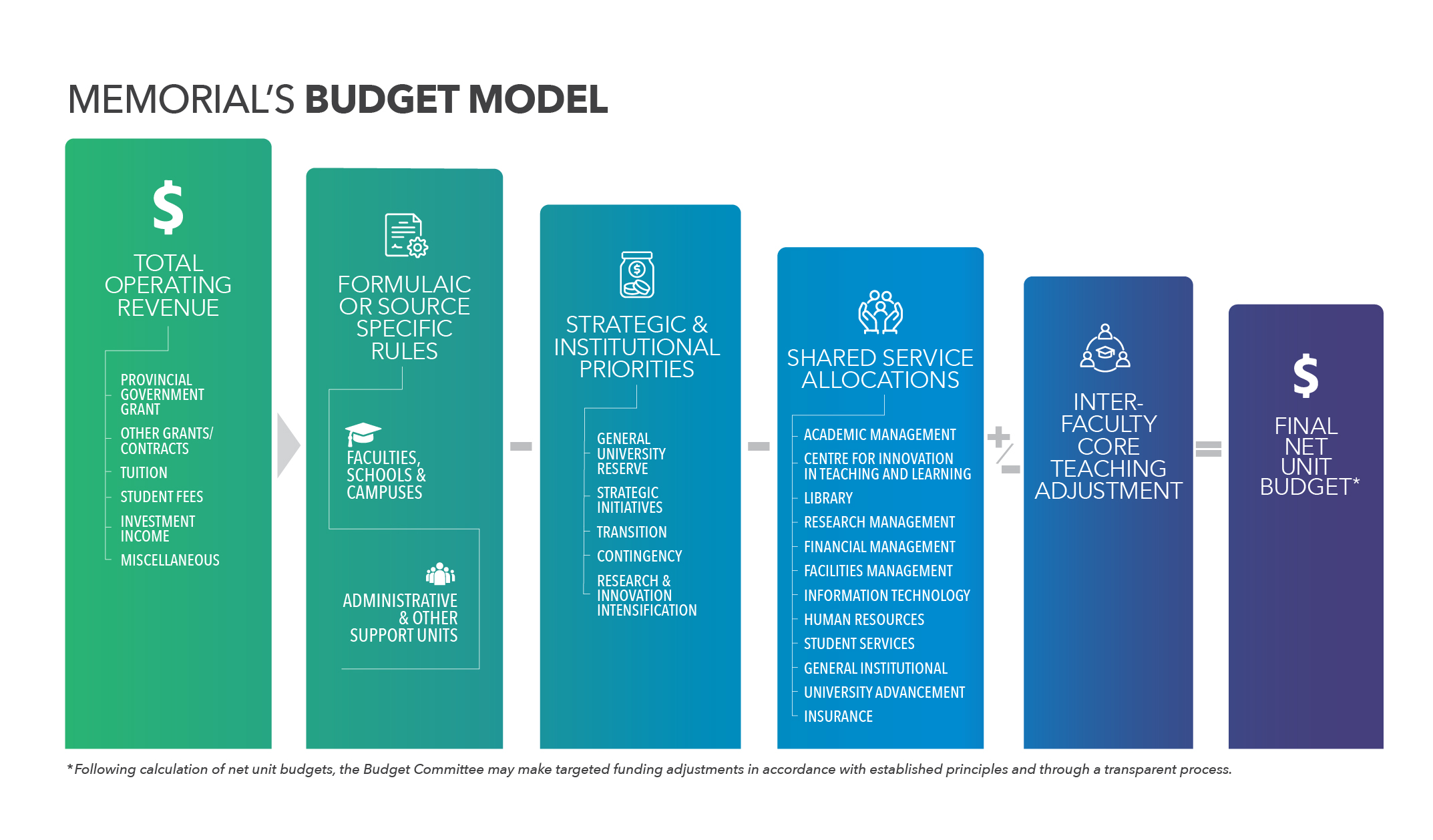 This model assumes faculties/schools receive the revenue they generate; and they are responsible for costs associated with the academic and administrative support of their programs (e.g., facilities management, human resources). The model also features a General University Fund to provide opportunities for strategic funds and institutional contingencies. An accountability framework is also an important component that will accompany the budget model. It provides a high level of transparency in allocations and decision making, which responds to longstanding calls from students, employees, unions, alumni and government for a clearer understanding of how resources are allocated across Memorial.
| Current Budget Model | Future Model | |
|---|---|---|
| Basis for Allocation | Budgets are largely based on historical allocations. | Funding is more directly connected to revenues generated by faculties and schools. |
| How funding changes | Changes tend to happen incrementally year-over-year. | Allocations respond more directly to activity, revenue and agreed cost drivers. |
| Revenue incentives | Additional revenue generation does not directly change a unit’s budget allocation. | Units have a clearer connection between revenue generating activity and the resources they receive. |
| Institutional costs | Shared and institutional costs are largely managed centrally and may be less visible to units. | Academic units are allocated a defined share of institutional and shared service costs using agreed upon methodologies. |
| Responsiveness | Resource allocations can be difficult to adjust as enrolment patterns, costs or institutional priorities change. | The model provides greater visibility into how changing activity and revenues affect unit financial positions. |
| Transparency | Allocation decisions can be difficult to trace or understand, sometimes described as a “black box.” | Revenue, expense and cost allocation methodologies are designed to be clear and transparent. |
| Decision-Making | Highly centralized. | More decentralized, with greater financial responsibility and accountability at the faculty/school level. |
Where we are now and where we are going
Memorial is in a multi-year transition to a Memorial budget model that will be implemented in 2028–29.
The work is now moving from model development into a deeper period of testing, learning and engagement that will involve all interested members of the Memorial community.
What is happening now?
Leaders across academic and administrative units and campuses are working closely with Finance and the Transformation Offices to:
- review unit level and cost area results;
- validate data, assumptions and cost drivers;
- examine expected and unexpected variances;
- assess academic, administrative and operational implications;
- identify questions requiring further analysis; and
- identify where model, transition, training or support needs may require further consideration.
Feedback and validation findings will be documented and assessed. Potential refinements to methodologies, cost drivers, assumptions and allocation approaches will inform future iterations of the shadow budget.
We remain committed to releasing shadow budget results to the broader Memorial community in the Winter semester 2027. At that time, we intend to share not only the results, but what we have learned through this extended review and additional context to support more informed and meaningful conversations.
Important note: shadow budget results do not change approved unit budgets, do not represent final allocations and should not be interpreted as indicators of future funding decisions or judgements about the value of a faculty, program or activity.
What is a shadow budget?
In simple terms, it is a structured financial modelling exercise. It applies the proposed budget methodology to Memorial’s financial information so we can see how the results would look under a different approach. It does not replace approved budgets and does not direct units to make the changes shown in the shadow results.
The shadow period gives us time to understand what the numbers reveal, validate the data and assumptions behind them, hear from the people closest to the work and identify where the model, or its supports, may need to be refined.
This modelling exercise provides visibility into how revenues, expenses and resources flow across Memorial and where different financial pressures exist.
A budget model cannot determine Memorial’s priorities or the value of our academic and institutional activities on its own.
What we learn through this process will be considered alongside other information and institutional priorities, as we refine a Memorial specific budget model and prepare for implementation.
| The Shadow Budget Does | The Shadow Budget Does Not |
|---|---|
| Apply the proposed methodology to real institutional data | Replace approved unit budgets |
| Make revenues, costs and resource flows more visible | Represent approved future allocations |
|
Test assumptions, methodologies and cost drivers
|
Direct units to make the changes shown in the results |
| Surface questions, variances and areas requiring further analysis | Rank the academic or institutional value of units or programs |
| Inform consultation and refinement | Make future budget decisions on its own |
Information on the new budget model development and implementation will continue to be posted here and shared with the university community.