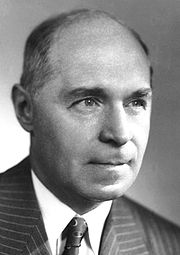
Hermann Joseph Muller (1890 – 1967) was an American geneticist who established the mutagenic properties of X-rays. At Columbia University, he joined TH Morgan’s "Fly Room", where he contributed to the chromosome theory of inheritance. Investigation of new mutant forms was limited by the their infrequent occurence in vivo. In 1927, at the University of Texas, Muller demonstrated that ionizing X-rays greatly increased mutation rates in Drosophila. This provided a powerful tool for the analysis of genes and chromosomes, and raised concern about radiation’s hereditary effects. In 1946, he received the Nobel Prize in Physiology or Medicine for this discovery.
Muller’s Marxist views shaped his views on the social uses
of genetics, and brought him into conflict with conservative
politics of the time and place. He argued that poverty and
unequal opportunity prevented reliable judgments about
hereditary differences in human ability, and he attacked the
racism and class prejudice inherent in then-contemporary
"negative" eugenics. He advocated a socialist form of
"positive' eugenics, through which voluntary reproductive
choices would improve human heredity after social reform
established equal opportunity. From 1932, he conducted
genetic research in the Soviet Union, where he hoped
socialism would support genetics and its humanitarian
applications. His defense of Mendelian genetics brought him
into direct conflict with TD
Lysenko, and Stalin’s support for Lysenko helped
destroy those hopes. In 1937, Muller left the Soviet Union,
and in 1945, he joined Indiana University, where he
continued his research and public advocacy for radiation
protection and opposition to nuclear weapons testing.