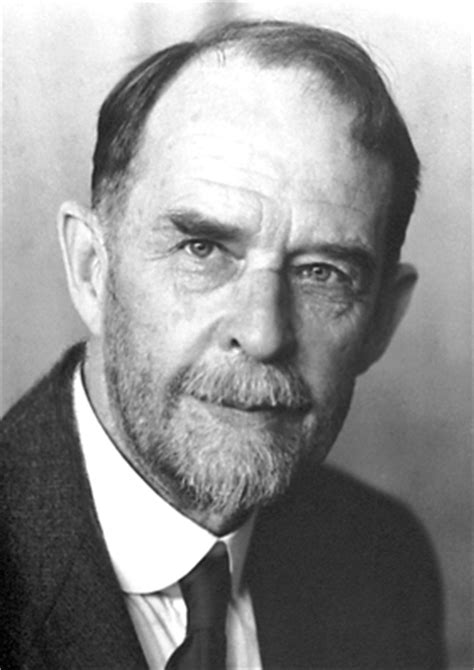
Thomas Hunt Morgan (1866 - 1945)
Thomas Hunt Morgan (1866 – 1945) was an American zoologist whose experiments with Fruit Flies (Drosophila melanogaster) definitively established the chromosome theory of heredity. Born in Lexington, Kentucky, he earned his doctorate at Johns Hopkins University in 1890, and became professor of experimental zoology at Columbia University in 1904. In one of his earliest books, he expressed doubted both as to the Mendelian explanations of heredity, and the claim that chromosomes carried hereditary factors.
At Columbia, Morgan chose the fruit fly, Drosophila melanogaster, for genetic experiments because of its easy care, short generation time, and large numbers of offspring per cross. In 1910, he discovered a male fly with a novel white eye phenotype among flies with typical red eyes. Carefully controlled crossing experiments showed that the gene for the white eye-colour trait was located on the X chromosome, the first definitive assignment of a gene to a specific chromosome, and the first occurence of sex-linked heredity. With Alfred Sturtevant, Calvin Bridges, and Hermann Muller, he showed that genes responsible for specific trait occupied specific positions (loci) on chromosomes. Their research showed that these genes occurred in a specific physical order, and that recombination frequencies in controlled crosses could reveal their relative distances.
Morgan’s laboratory
became the leading center for genetic research, and the "Fly
Room" launched several younger scientists on
influential careers. His books, The
Mechanism of Mendelian Heredity (1915,
coauthored with Sturtevant, Muller, and Bridges), and The
Theory of the Gene (1926), brought
chromosome genetics to a broad scientific audience, and laid
the groundwork for similar work in other species. In 1928 he
moved to the California Institute of Technology to direct its
new biology division. He received the Nobel Prize in
1933 for his discoveries concerning the role of chromosomes in
heredity.