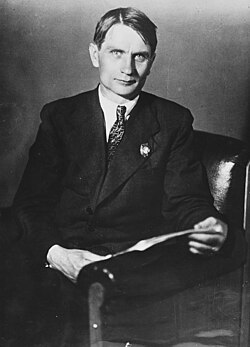
Trofim Denisovich Lysenko (1898 - 1976)
"Even the fruit flies were killed ...."
Trofim Denisovich Lysenko (1898–1976) was a Soviet agronomist and biologist who rose to power under Joseph Stalin. He came from a peasant family in Ukraine, and gained fame for his work on crop growth. He promoted a method called vernalization, which used cold treatment to alter the growth cycle of seeds, for example conversion of Spring to Winter Wheat. Lysenko argued that changes in an organism’s environment could produce changes passed on to the offspring, i.e., inheritance of acquired characteristics. Soviet leaders praised his ideas because they were consistent with Marxist theory, that all systems could be changed by work. They also promised higher crop yields almost immediately, rather than by slow, proven methods of selection on Mendelian traits
Appointed Director of the Institute of Genetics in
1940, he rejected the science of genetics and even denied the
existence of genes and chromosomes, condemning it as
"Mendelian - Morganist pseudoscience". He adopted increasingly bizarre
notions of biology, and attracted other charlatans to his
circle. The American
geneticist Herman
Muller, was forced out of the Soviet
Union. With Stalin’s support, he drove many leading geneticists from their positions, some of whom faced prison or death. A notable victim was
Nikolai
Vavilov (1887 - 1943), an internationally famed
and respected geneticist, who was sentenced to death and
died in the Gulag. At
the Zhdanov Congress of 1948 that was intended to be a
debate of genetics vs Lysenkoism, he achieved a complete coup
over Soviet biology, by reading a statement of political
support from Stalin and the Central Committee. His theories lacked any scientific
credibility, and his results were faked, yet the Soviet government treated them as official doctrine for many years. His policies harmed agricultural research, and helped weaken Soviet crop production. After Stalin’s death in 1953, he continued to be
supported by NS Khrushchev, and continuing crop failures
contributed to the latter's fall in 1964. Thereafter,
following severe criticism of his methods and lack of results,
Soviet officials removed him from his positions of influence in 1965. Czechoslovakia issued a
centennial postage stamp with Mendel's picture in 1965.
Lysenko stifled a generation of Soviet genetics, which had been one of the leading centers of world research. His views were adopted in China, with disastrous crop failures, and taught in the Eastern Bloc to the exclusion of genetics. Today, scientists regard his work as a major example of how political power can damage science.