Quantitative
"Real Time"
RT-PCR as a " + / - "
test
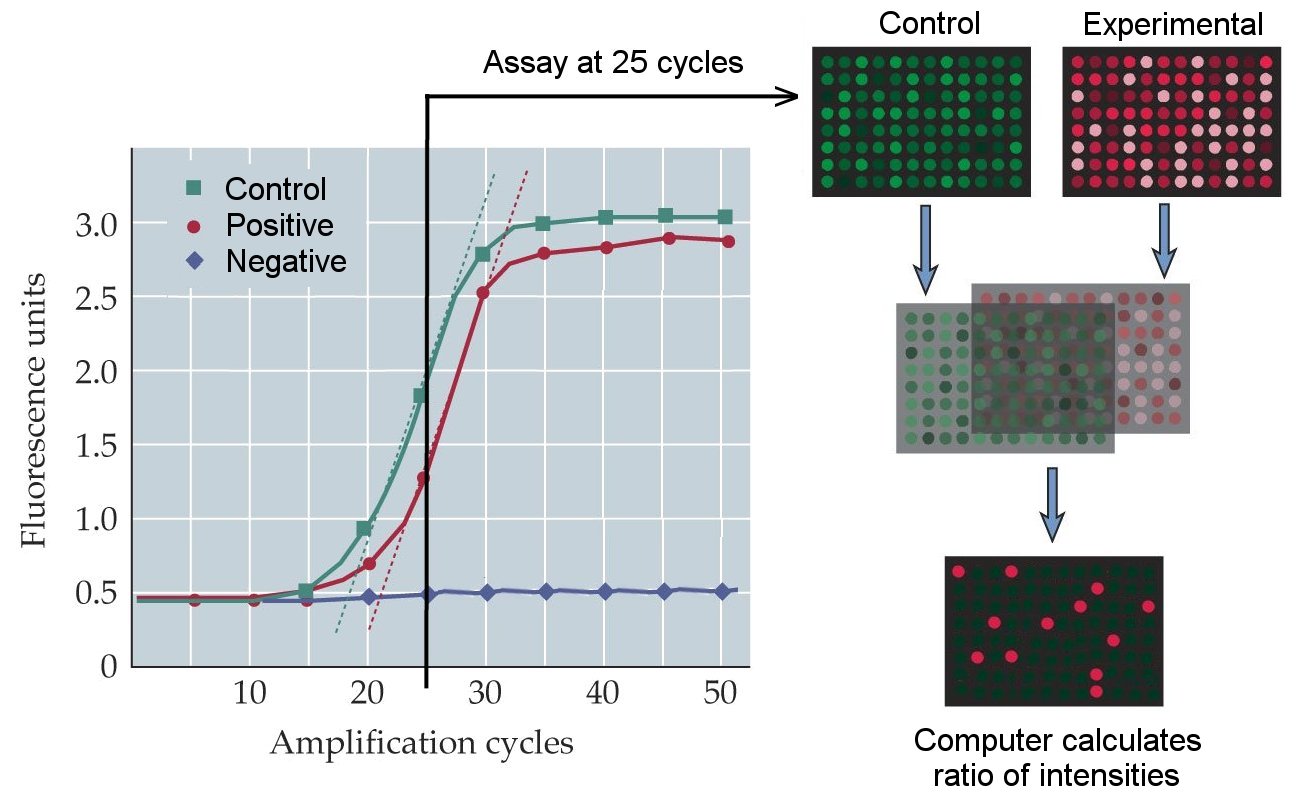
Progress of DNA amplification during a Polymerase Chain Reaction
(PCR) can be monitored in
"real time"
(RT-PCR) by measuring the
release of fluorescent "flashes" during amplification. Reaction rates can be measured
continuously, or
determined at a fixed time-point during the exponential
amplification phase. A computer measures the rate of
"flashing" in 96 simultaneous experimental PCR reactions relative to a control reaction
in
the same tube (top, right). A "positive" result ("red"
signals, below right) indicates that the target DNA sequence is present.
Because amplification is measured against a control, a "negative"
("black" background
signal) is a definite indication of the absence of the target
allele.
Unlike ordinary preparative PCR, RT-PCR allows the success of
multiple PCR reaction to
be determined automatically after only a few cycles, without
separate analysis of each reaction, and avoids the problem of "false negatives".