Quantitative "Real-Time" (RT) PCR
The Polymerase Chain
Reaction (PCR)
is ordinarily a preparative or qualitative procedure
used to produce a large quantity of DNA for analysis. Quantitative PCR (qPCR)
is an analytical procedure to determine how
much DNA is present.
A
qPCR reaction besides the usual PCR components
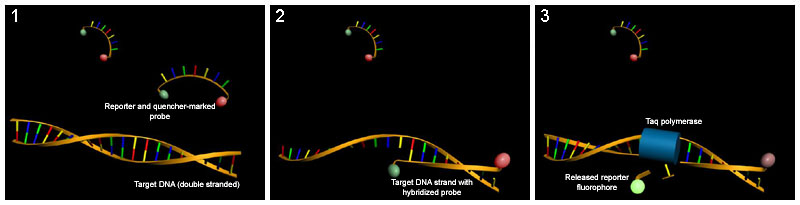
includes a single-stranded ssDNA "Reporter /
Quencher" probe that
binds to the 3' end of dsDNA template of
interest. When bound to the DNA
strand, the "Quencher"
prevents the "Reporter"
from fluorescing. As the Taq polymerase extends
the PCR copy, the Reporter
end is displaced first, while the Quencher end remains bound.
The Reporter is "un-quenched" and releases
a quantum flash of light at a particular wavelength. The
number of flashes recorded during each cycle equals the count
of replications. Progress of the PCR is monitored in
"real time" by the cumulative count of flashes.
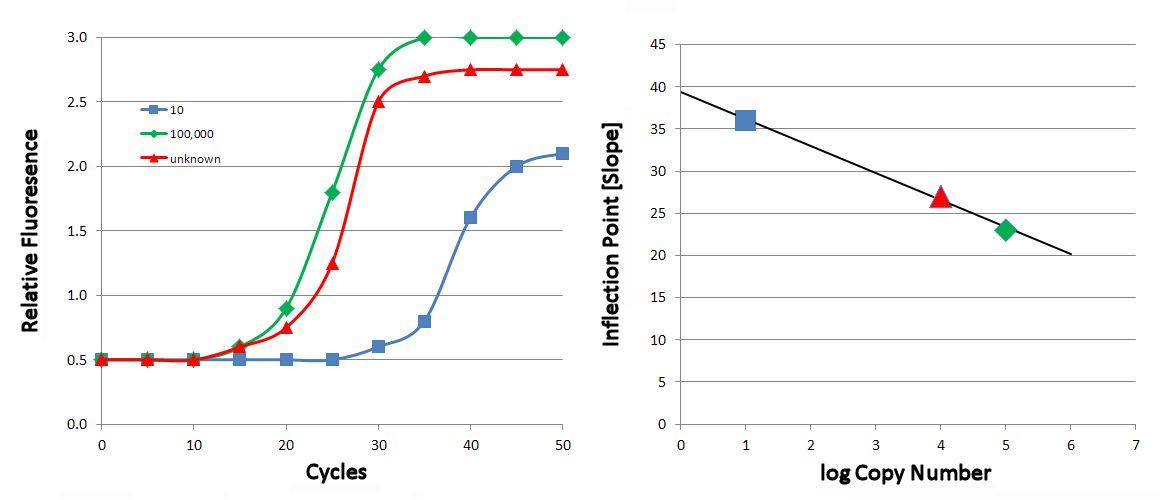
The number of PCR
cycles required for the amplification to shift from the
initial linear to the exponential phase is an indication of
abundance of the original template [left]. The slope of a plot
of the inflection points of the reaction curves for
known initial concentrations (in the example, squares and diamonds for 10 and 100,000 initial copies] can be used
to draw a log-linear standard curve [right]. This
allows the number of initial gene copies in an unknown sample
[triangle] to be calculated.
Biodiversity
applications: Use of species-specific PCR
primer sequences would allow monitoring of any one
species against a diverse background, for example, the
relative abundance of Atlantic Cod in the stomach contents of
Harp Seals.