A stable equilibrium
 (where
  q = 0) is reached
when the rate of replacement (by mutation)
balances the rate of removal (by selection).
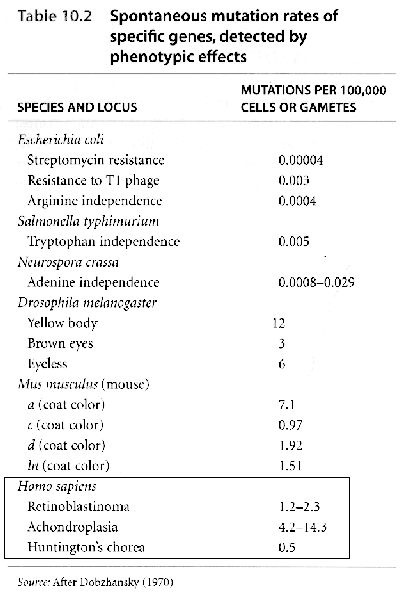
Deleterious alleles are maintained by recurrent mutation.
A stable equilibrium(where q = 0) is reached
when
the
rate of replacement (by mutation)
balances
the
rate of removal (by selection).
µ =
frequency of new mutant alleles per locus per generation
typical µ
= 10-6: 1
in 1,000,000 gametes has new mutant
_____
then = (µ / s)
[see derivation]
(µ / s)
[see derivation]
Ex.: For a recessive lethal allele (s = 1)
with a mutation rate of µ = 10-6
then  = û
= (10-6 / 1.0) = 0.001
= û
= (10-6 / 1.0) = 0.001
mutational
genetic load
Lowering
selection against alleles increases their frequency.
Medical
intervention
has increased the frequency of heritable conditions
in Homo (e.g., diabetes, myopia)
Eugenics: modification of human
condition by selective breeding
'positive eugenics': encouraging people with "good genes"
to breed
'negative eugenics': discouraging people with 'bad
genes'' from breeding
e.g., immigration control, compulsory sterilization
[See: S. J. Gould, "The Mismeasure of Man"]
Is eugenics effective at reducing frequency of
deleterious alleles?
What
proportion
of 'deleterious alleles' are found in heterozygous carriers?
(2pq) / 2q2 = p/q  1/q (if q << 1)
if s = 1 as above, ratio is 1000 / 1 : most of
variation is in heterozygotes,
not subject to selection
Directional selection is balanced by influx of 'immigrant'
alleles;
a
stable
'equilibrium' can be reached iff migration rate constant.
Consider an island adjacent to a
mainland, with unidirectional
migration to the island.
The fitness values of the AA,
AB, and BB genotypes differ in the two
environments,
so
that the allele frequencies differ between the mainland (qm)
and the island (qi).
| AA | AB | BB | ||
|
|
W0 | W1 | W2 | q |
| Island | 1 | 1-t | 1-2t | qi 0 |
| Mainland | 0 | 0 | 1 | qm 1 |
B has high fitness on
mainland, and low fitness on island.
[For this model
only, allele A is semi-dominant to allele B,
so
we use t for the selection coefficient to avoid
confusion]
m = freq.
of new migrants (with qm)
as fraction of residents (with qi)
if
m << t qi = (m / t)(qm) [see derivation]
Gene flow can hinder optimal adaptation of a population to local conditions.
Ex:
Water snakes (Natrix
sipedon) live on islands in
Lake Erie (Camin & Ehrlich
1958)
Island Natrix mostly unbanded; on adjacent
mainland, all banded.
Banded
snakes
are non-cryptic on limestone islands, eaten by gulls
Suppose A = unbanded
B = banded [AB are intermediate]
Let qm =
1.0 ["B" allele is fixed on
mainland]
m = 0.05 [5% of island snakes are
new migrants]
t = 0.5
so W2 = 0 ["Banded" trait
is lethal on island]
then qi =
(0.05/0.5)(1) = 0.05
and Hexp = 2pq
= (2)(0.95)(0.05) 10%
i.e, about 10% of snakes show intermediate banding,
despite strong selection
=>
Recurrent migration can maintain a disadvantageous trait at high frequency.
Inbreeding is the mating of
(close) relatives
or,
mating
of individuals with at least one common ancestor
F (Inbreeding
Coefficient) = prob. of "identity by descent":
Probability
that
two alleles are exact genetic copies of an allele in the common
ancestor
This
is
determined by the consanguinity
(relatedness) of
parents.
Inbreeding reduces Hexp by a
proportion F
(&
increases
the proportion of homozygotes). [see derivation]
f(AB) = 2pq (1-F)
f(BB) = q2 + Fpq
f(AA)
=
p2 + Fpq
Inbreeding
affects genotype proportions,
inbreeding
does
not affect allele frequencies.
Inbreeding increases the frequency of individuals
with
deleterious
recessive genetic diseases by F/q [see derivation]
Ex.: if q = 10-3
and F = 0.10 , F/q = 100
=>
100-fold
increase in f(BB) births
Inbreeding coefficient of a population can be estimated from experimental data:
F = ( 2pq - Hobs ) / 2pq [see derivation]
|
|
|
|
|
|
|
|
|
|
|
|
|
|
|
|
since p = 0.226 +
(1/2)(0.400) = 0.426
&
q = 0.374 + (1/2)(0.400) = 0.574
Then F = (0.489 - 0.400) /
(0.489) = 0.182
which is
intermediate between Ffull-sib
= 0.250
& F1st-cousin = 0.125
=> Mice
live in small family groups with close inbreeding
[This
is
typical for small mammals]
However,
in
combination with natural selection, inbreeding can be
"advantageous":
increases rate of evolution in the long-term (q 0 more quickly)
deleterious
alleles
are eliminated more quickly.
increases phenotypic variance (homozygotes are
more common).
advantageous
alleles
are also reinforced in homozygous form
Genetic Drift is stochastic q [unpredictable,
random]
(cf. deterministic q [predictable,
due to selection, mutation, migration)
Sewall Wright (1889 - 1989): "Evolution and the Genetics of Populations"
Stochastic q is greater than
deterministic q in small populations:
allele
frequencies
drift more in 'small' than 'large' populations.
Drift
is most noticeable if s 0, and/or N small (<
10) [N
1/s]
q drifts between
generations (variation decreases within
populations over time) [];
eventually,
allele
is lost (q = 0) or fixed (q = 1) (50:50
odds)
Ex: NatSel Laboratory Exercise
#4
[Try: q = 0.5, W0 = W1 = W2 = 1.0, and N = 10, 50, 200, 1000]
q drifts among
populations (variation increases among
populations over time);
eventually,
half
lose the allele, half fix it.
**=> Variation is 'fixed' or 'lost' & populations will diverge by chance <=**
Evolutionary
significance:
"Gambler's Dilemma" : if you play long enough, you win or
lose everything.
All
populations
are finite: many are very small, somewhere or
sometime.
Evolution
occurs
on vast time scales: "one in a million chance" is
a certainty.
Reproductive
success
of individuals in variable: "The race is not to the
swift ..."
What happens in the really long run?
Effective Population Size (Ne)
=
size
of an 'ideal' population with same genetic variation (measured
as H)
as
the
observed 'real' population.
=
The
'real' population behaves evolutionarily like one of size Ne :
the
population
will drift like one of size Ne
loosely,
the number of breeding individuals in the population
Consider three special cases where Ne < or << Nobs [the 'count' of individuals]:
(1) Unequal sex ratio
Ne = (4)(Nm)(Nf) /
(Nm + Nf)
where Nm & Nf are
numbers of breeding males & females, respectively.
"harem" structures in mammals (Nm <<
Nf)
Ex.: if Nm = 1 "alpha male"
and Nf = 200
then Ne =
(4)(1)(200)/(1 + 200) 4
A
single
male elephant seal
(Mirounga) does most of the breeding
[Elephant
seals
have very low genetic variation]
eusocial (colonial) insects
like ant & bees (Nf << Nm)
Ex.: if Nf = 1 "queen" and Nm=
1,000 drones
then Ne =
(4)(1)(1,000)/(1 + 1,000) 4
Hives
are
like single small families
(2) Unequal
reproductive success
In stable population, Noffspring/parent = 1
"Random" reproduction follows Poisson
distribution (N = 1  1)
1)
(some
parents
have 0, most have 1, some have 2 or 3 or more)
| X |  |
Ne = | Reproductive strategy |
| 1 | 1 | Nobs | Breeding success is random |
| 1 | 0 | 2 x Nobs | A zoo-breeding strategy |
| 1 | >1 | < Nobs | K-strategy, as in Homo |
| 1 | >>1 | << Nobs | r-strategy, as in Gadus |
(3) Population size variation over time
Ne = harmonic mean of N = inverse of
arithmetic mean of inverses
[a
harmonic
mean is much closer to lowest value in series]
n
Ne = n / [  (1/Ni)
] where Ni = pop size in
i th generation
(1/Ni)
] where Ni = pop size in
i th generation
i=1
Populations exist in changing environments:
Populations
are
unlikely to be stable over very long periods of time
10-2 forest fire / 10-3 flood / 10-4
ice age
Ex.: if typical N = 1,000,000 & every
100th generation N = 10 :
then Ne = (100) / [(99)(10-6)
+ (1)(1/10)]
100 / 0.1 = 1,000
Founder Effect & Bottlenecks:
Populations
are
started by (very) small number of individuals,
or
undergo
dramatic reduction in size.
Ex.: Origin of Newfoundland moose (Alces):
2
bulls
+ 2 cows at Howley in 1904
[1
bull
+ 1 cow at Gander in 1878 didn't succeed].
Population cycles: Hudson Bay Co.
trapping records (Elton 1925)
Population
densities
of lynx, hare, muskrat cycle over several orders of magnitude
Lynx
cycle
appears to "chase" hare cycle
The effect of drift on genetic variation in populations
Larger
populations
are more variable (higher H) than smaller
if s = 0: H reflects balance between loss
of alleles by drift
and
replacement
by mutation
H = (4Neµ) / (4Neµ + 1)
Ex.: if µ= 10-7 & Ne = 106 then Neµ = 1 and Hexp = (0.4)/(0.4 + 1) = 0.29
But typical Hobs 0.20 which suggests Ne
105
0.20 which suggests Ne
105
Most
natural
populations have a much smaller
effective size than their typically observed size.
Ex.: Gadus morhua in W.
Atlantic were confined to Flemish
Cap during Ice Age 8 ~ 10,000 YBP
mtDNA sequence variation occurs as "star phylogeny":
most
variants
are rare and related to a common surviving genotype
Carr et al. 1995 estimated Ne = 3x10⁴ as compared with Nobs 109
Effective
size
is ca. 5 orders of magnitude smaller than observed
Stochastic
effects
may often be more important than deterministic processes in
evolution.