Genes, Environment, & The
Norm of Reaction [ I ]
"Is
the variation genetic or environmental?"
Genes, Environment, & The
Norm of Reaction [ I ]
"Is
the variation genetic or environmental?"
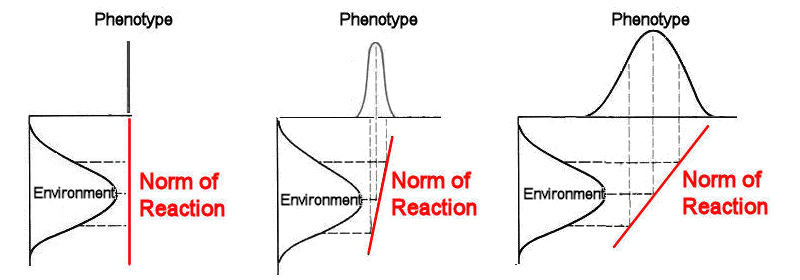
The Norm of Reaction is a multi-locus genetic curve that relates the contribution of environmental variation to observed phenotypic variation. The norm of reaction curve can be thought of as a genetic mirror that reflects the environmental into phenotypic space.
Consider a breed of cattle that with a single locus that influences milk-fat content. If the Norm of Reaction is flat [left], the phenotype produced over the entire range of environments (X-axis) is constant (flat line, Y-axis). This corresponds to the ordinary concept of a "genetic" trait: a particular genotype always produces exactly the same phenotype irrespective of environment. Classic single-gene traits fall into this category: peas are round (RR, Rr) or wrinkled (rr) according to genotype, irrespective of environment