Williams Syndrome
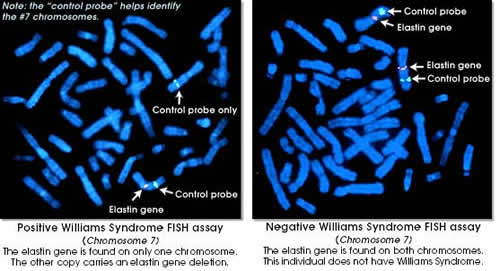
Williams Syndrome is the result of a segmental
aneuploid deletion of a small portion of the long arm of
Chromosome 7 (2n = 46, 7q11.23-). The fluorescence in situ
hybridization (FISH) image for the standard karyotype
[above, right] with two complete chromosomes shows
binding of a control
probe for another locus on the 7q arm, along with
an experimental probe for the elastin gene locus, which is present in
the q11.23
region on each of two
medium-sized metacentric chromosomes. The Williams karyotype
(above, left) shows one standard chromosome, to which
both probes bind, and one segmental aneuploid chromosome in which
only the
control probe binds, which indicates a segmental
deletion of q11.23.
According to the Williams Syndrome Association, children with Williams Syndrome are characterized by "[S]mall upturned nose, long philtrum (upper lip length), wide mouth, full lips, small chin, and puffiness around the eyes. Blue and green-eyed children with Williams syndrome can have a prominent "starburst" or white lacy pattern on their iris." Medical conditions include narrowing of the aorta (aortic stenosis) and/or pulmonary arteries, hypercalcemia (elevated blood calcium levels), low birth-weight and/or "failure to thrive", dental anomalies, renal anomalies, inguinal hernia, hyperacusis (hearing sensitivity, "startle response"), low muscle tone and joint laxity.
"Individuals with Williams syndrome have a very endearing personality. They have a unique strength in their expressive language skills, and are extremely polite. They are typically unafraid of strangers and show a greater interest in contact with adults than with their peers.... Most people with Williams syndrome have mild to severe learning disabilities and cognitive challenges. Young children with Williams syndrome often experience developmental delays. Milestones such as walking, talking and toilet training are often achieved somewhat later than is considered normal. Distractibility is a common problem in mid-childhood, which can improve as the children get older... Older children and adults with Williams syndrome often demonstrate intellectual "strengths and weaknesses."
For the advanced student: What is the purpose of the Control Probe? Suppose you are a genetic counselor and perform the FISH test on a newborn child. What is your interpretation if (1) The karyotype shows binding of both the control and elastin probes to only one chromosome, (2) the karyotype shows binding only of the elastin probe, either (a) to one chromosome only, or (b) two both chromosomes, or (3) The karyotype does not show binding of either the control or elastin probes.
According to the Williams Syndrome Association, children with Williams Syndrome are characterized by "[S]mall upturned nose, long philtrum (upper lip length), wide mouth, full lips, small chin, and puffiness around the eyes. Blue and green-eyed children with Williams syndrome can have a prominent "starburst" or white lacy pattern on their iris." Medical conditions include narrowing of the aorta (aortic stenosis) and/or pulmonary arteries, hypercalcemia (elevated blood calcium levels), low birth-weight and/or "failure to thrive", dental anomalies, renal anomalies, inguinal hernia, hyperacusis (hearing sensitivity, "startle response"), low muscle tone and joint laxity.
"Individuals with Williams syndrome have a very endearing personality. They have a unique strength in their expressive language skills, and are extremely polite. They are typically unafraid of strangers and show a greater interest in contact with adults than with their peers.... Most people with Williams syndrome have mild to severe learning disabilities and cognitive challenges. Young children with Williams syndrome often experience developmental delays. Milestones such as walking, talking and toilet training are often achieved somewhat later than is considered normal. Distractibility is a common problem in mid-childhood, which can improve as the children get older... Older children and adults with Williams syndrome often demonstrate intellectual "strengths and weaknesses."
For the advanced student: What is the purpose of the Control Probe? Suppose you are a genetic counselor and perform the FISH test on a newborn child. What is your interpretation if (1) The karyotype shows binding of both the control and elastin probes to only one chromosome, (2) the karyotype shows binding only of the elastin probe, either (a) to one chromosome only, or (b) two both chromosomes, or (3) The karyotype does not show binding of either the control or elastin probes.
See [http://www.williams-syndrome.org/]

Fraser (second from left) & friends