Origin
of Fragile-X
Syndrome through slipped-mispair
recombination
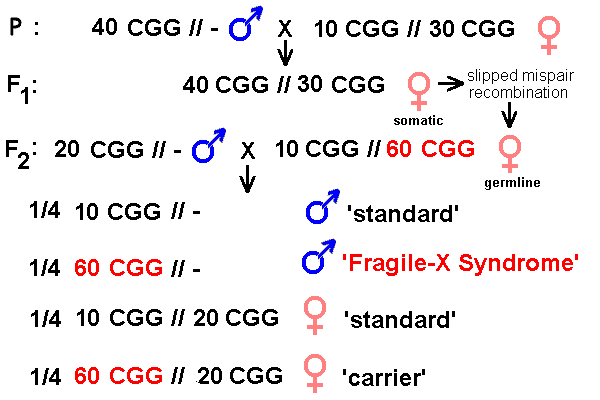
In the P generation,
an XY man hemizygous for an X-chromosome
with a 40-fold CGG repeat marries a woman heterozygous for X-chromosomes
with 10- and 30-fold CGG repeats. Their F1 daughter inherits the 40 CGG
repeat from her father, and the 30CGG repeat from
her mother. In her germline,
slipped-mispair
recombination results in production of eggs
with 10- or 60-fold CGG repeats. Because
the event occurs only in
her germline and not in the somatic tissues, she does not show the
syndrome, even though the
threshold for expression of Fragile-X syndrome is ~55CGG
repeats
In the F2 generation, the daughter
marries a man with a 20-fold CGG repeat. One-half
of their sons will inherit the 60 CGG X chromosome and will likely show Fragile-X syndrome, and
one-half of their daughters will be carriers. Further
slippage of the repeat region may occur in the F3 daughters' germlines. These daughters may or may
not show the syndrome themselves: the phenotype is sex-influenced,
with higher penetrance
in males (80%) than females (30%), which may be due to the
compensating presence of a 'standard' X-chromosome in heterozygous females.