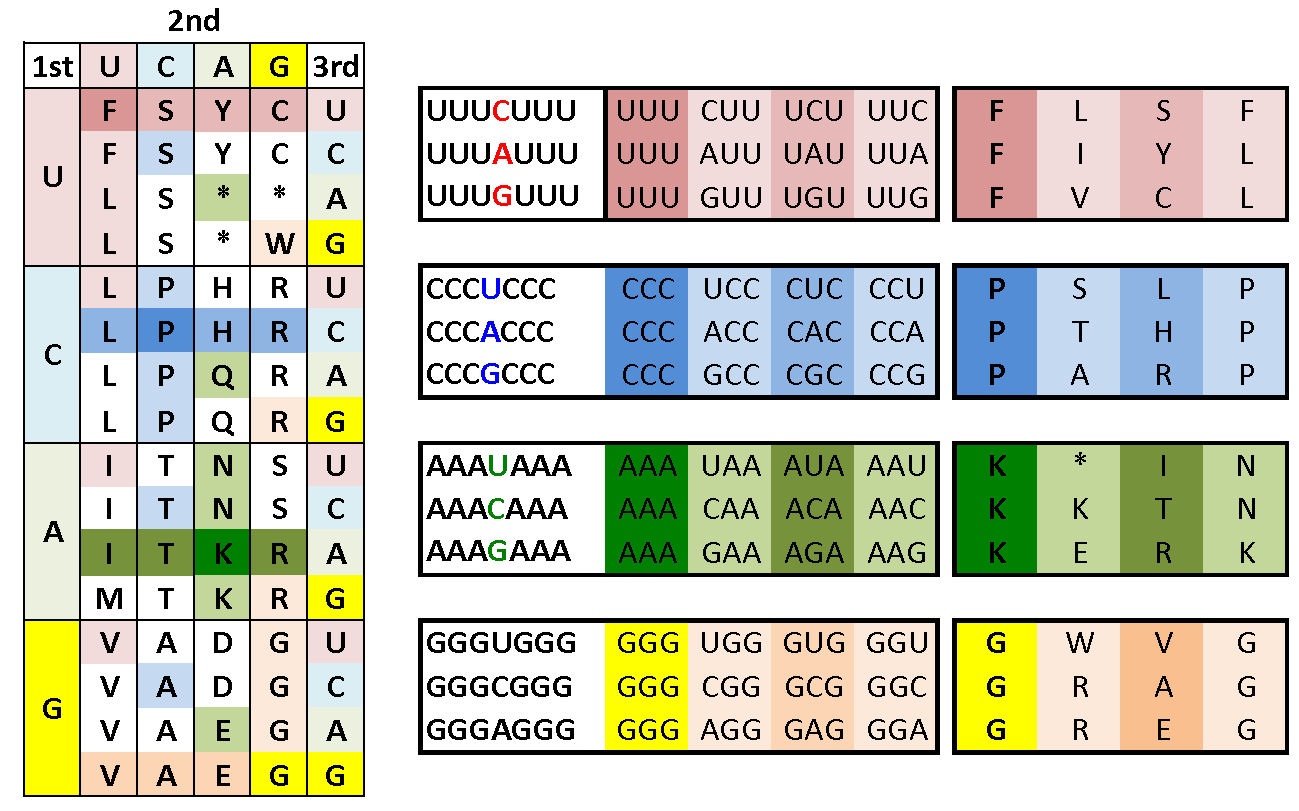
Inference
of the Universal Genetic Code from "spiked"
monomeric syntheses
Inferences from
assembly of repeating RNA monomers and dimers allow
decoding of 16 codons (HOMEWORK:
Prove this). The monomer synthesis reactions (UUU CCC AAA GGG)
can be 'spiked ' by adding a small fraction of each
of the other three bases in separate reactions. For example, the
experiment on the first line in the top box shows that
introduction of a small amount of C
into a poly-U mix will create a few CUU
UCU
and UUCcodons at random in a predominantly UUU message. UUU
produces F (phe) as previously shown, and two
of the other three produce L and S as well. The
coding arrangement is not obvious. However, given a hypothesis
that changing the first or secondletter
of a codon changes the amino acid, but changing the third
doesn't, perhaps UUU and UUCboth
code for F. [An honors student waves her hand, and points
out that U and C are both pyrimidines. Hmmm
....]
Folks working in the same lab
at the next bench on the experiment shown on the third
line of the second box, introduction of a U spike into a
poly-C mix produces UCC,
CUC
and CCU,
and L and S, along with the expected P.
Comparison of the two experiments at the next lab meeting shows
that both spiked reactions produce L and S, along
with P. Given a
third-position hypothesis from the first experiment,
CCC and CCU probably produce P, and someone
will notice that the pairs CUU and CUC, and UCU
and UCC, fit this pattern. So, CUNand
UCNcode for L and S, but which is
which is still uncertain.
Folks working at the third bench on the experiment on the third
line in the third box shows that introduction
of a small amount of G into a poly-Amix will create a few GAA,
AGA
and AAGcodons at random in a predominantly AAA message.
AAA produces K (xxx) as previously
shown, and two of the other three produce E and R
as well. If maybe the code wort of "Wobbles",
perhaps AAA and AAGboth code for K. [Another student points
out over coffee that A and G are both purines].
Folks at the fourth bench on the
experiment shown on the third line of the fourth box,
find that introduction of an A spike into a poly-G mix produces AGG,GAG, and
GGA codons, and amino acids E and
R, along with the expected amino acid G.
Comparison of the third and fourth experiments at the local
pub shows that both spiked reactions produce R and E.
The "Wobble" hypothesis, as everyone now calls
it, predicts GGG and GGA produce amino acid
G. Then, the pairs GAA
and GAG,
and AGA
and AGG,
also fit the wobble pattern. So, AGNand AGNcode for R and E, but which is which is
still uncertain.
HOMEWORK:
Proceed in this fashion to see how many of the codons you
can 'crack'. Hint: Among all twelve
experimental outcomes shown above, what's unusual about
amino acids W and M ?