action, reaction, response = behavior
clear-cut cases
of genetic influences--known since early 1900s
field of psychology...
whole paradigm--Behaviorism (Watsonians
and Skinnerians)
"i do not
know what makes an animal hungry and i do not care"
nature-nuture...when
it was still a controversy
1950s--acceptance
of interaction:
"all behavior patterns are influenced both genetically and environmentally"
emergence of Behavior-Genetics...
development of approaches....
1. Behavior Differences in related organisms--evidence for genetic influence
- comparative approach:
behavior differences in genetic strains of species
rationale: if closely related organisms exist in similar
enviornments and their survival needs are identical, then any observed
behavioral differences may be due to genotypic differences
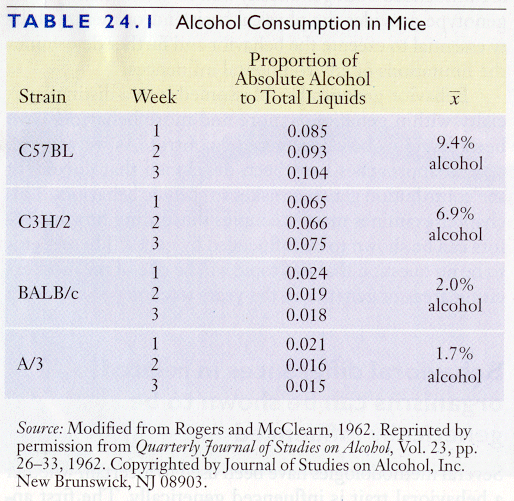
(A) Alcohol Preference
in Mice
- preference or aversion to ethanol in different strains
e.g. consumption
of 4 strains over 3 weeks
each strain--7 options for their "drinking pleasure" (pure H20, 2.5-15.0%
range)
some show preference, others aversion
(Table 24.1)
- raised over many generations in same environment
- therefore: genotypic differences = differences in alcohol preference
"presumably these strains vary only by
the fixation of different alleles at particular loci"
but: underlying
mechanism unclear!
suggested: differences
in primary enzymes of alcohol metabolism (e.g. ADH and AHD) may result
in these behavioral differences
to date: no correlation
between alcohol preference or metabolism and these biochemical markers
has been established (need for incorporation of other markers)
(B) Open-Field
Behavior in Mice
-study exploratory and emotional behavior
- new enviro = defecation and urination
in lab: grid floor enclosed box (record movements)
emotion (record sh*ts)
- different inbred strains = different open-field responses
DeFries et al. -
2 strains:
- BALB/cJ (albino) low exploration; very emotional
- C57BL/6j (normal) high exploration; low emotional
test: cross 2 strains
then interbred several generations
F2....Fn - cc, Cc, CC rats tested in open-field
in all cases:
- pigmented mice = behr of C57
- albino mice = behr of BALB
**conclusion: c
allele behaves pleiotropically
(coat color, behr)
heritability analysis (h2)...
this locus accounts for 12% of the variance in open-field activity
this locus accounts for 26% of the variance in sh*t-related emotion
therefore support
for polygenically
controlled
(i.e. other loci involved)
2. Modified Behavior may be artificially selected from heterogenous populations
-approach -organisms are artificially selected from a genetically heterogeneous
population that contains members that exhibit a behavioral trait.
rationale -if genetic strains can be established, where this behavior is
uniformly expressed, this trait can be transferred by genetic crosses to
another strain that initially does not exhibit the behavior under study,
the positive influence of the genotype is established.
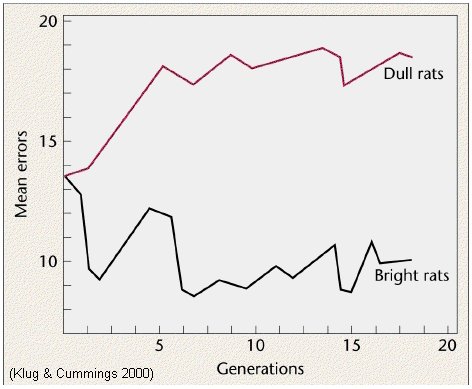
(A) Maze learning
in rats
Tolman 1924
82 white rats (heterozygous
ancestry)
measured ability "to learn" to obtain food (multiple T maze)
over trials errors decrease, eventually no errors (hungry rats)
from 82 selected: 9 pairs-"brightest"
and "dullest"
(two lines)
selection continued over generations...
other similar studies
(Tryon, 1942 - 18 selected generations Fig
24.2 )
*Cannot generalize studies to all intelligence
(IQ tests...)
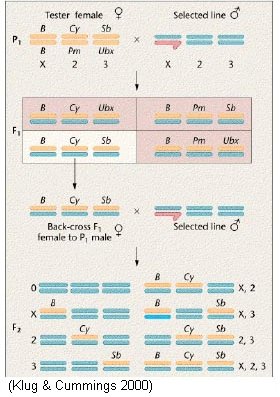
(B) Geotaxis in Drosphila
Hirsch et al.
mass screening device
flies added to vertical
maze
select for positive
and negative geotaxis (selection: 30 yrs, 500 gen's, 80,000 flies)
Conclusion: geotaxis under polygenic
control (i.e. more than one loci involved)
on chromosomes 2,3 and X... Fig
24.5
negatively geotaxis flies: gradient = 2>3>X
positively geotaxis flies: gradient = X>3>2
Conclusion: geotaxis is under polygenic
control and the loci involved are located on all 3 chromosomes
3. The effect of single genes that affect behavior can be studied.
Genetic crosses -
established inheritance patterns
many cases - no
simple Mendelian pattern
third approach:
Isolate and study the effects of single genes of behr
- mutation in a single gene may alter that behr
first step: defining a gene-controlling behr (then isolation, cloning,
molecular characterization)
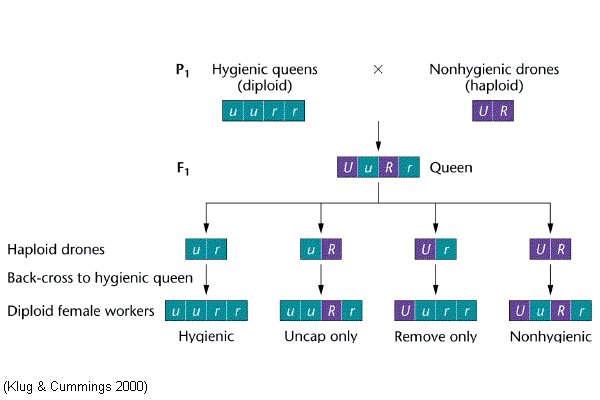
(A) Nest cleaning
in bees
nest infected with bacillus larvae
hygienic behr of worker bees
Rothenbuhler (1964)
- hygenic (brown) X nonhygenic (VanScoy) Fig
24.6
Conclusion: either a gene complex
or two independently assorting alleles (u and r) are responsible for hygienic
behr.
(B) Molecular motors in bacteria
E.coli and Salmonella
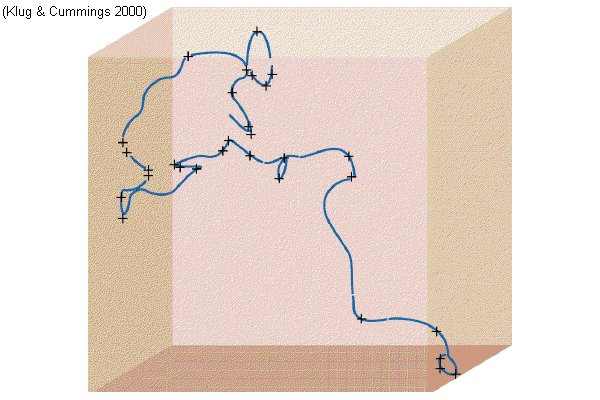
- move along chemical gradients; flagellar action controls (runs and tumbles)
Chemical attractant
- runs up the gradient extended (chemical repellant - vice versa) Fig
24.9
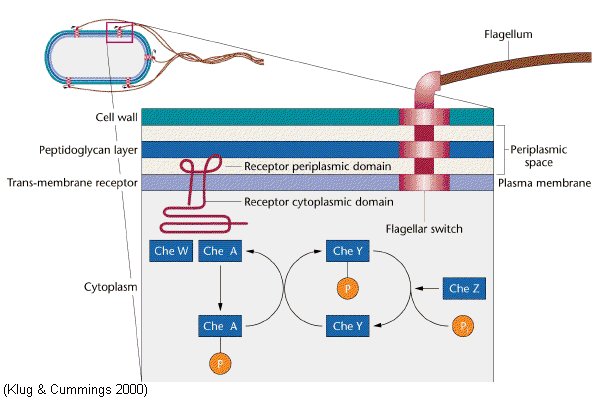
E. coli - membrane
spanning receptors, sense chemicals, initiate intracellular responses
*These receptor proteins equal products
of gene family called transducers*
Fig
24.10
Cytoplasmic surface of chemoreceptor protein + CheA/CheW = complex
- CheA and chemoreceptor - direct interaction
- CheW - enhances the association
- CheA mutants are non-chemotactic
What happens...
phosphorylation, molecular
switch, dephosphorylation
presence of attractant
- cycle reversed
Results suggests: signal transduction
is not initiated by the formation of the complex, but rather through conformational
changes in the complex brought about by sensory molecules
(C) Locomotor behr in mice
Waltzer mutation in mice ("I call it the
nellie")
Crosses (mutant X normal) - simple recessive
pattern (monohybrid mating)
this eg: mutation
- structural anomaly - alters
behr
4. C. elegans and the study of behavior genetics.
Sydney Brenner- study
the relationship between behr and the nervous system in c. elegans
Why c. elegans?
- simplicity
(959 somatic cells)
three classes of
behr was studied:
i. chemotaxis - many mutations have been isolated but
only 3 are characterized (+vely chemotactic for cAMP and GMP, anions and
cations)
ii. thermotaxis - cryophilic mutants move towards cooler
temperatures and thermophilic mutants move toward warmer temperatures (no
relation with nervous system)
iii. generalized movements - of 300 induced mutations,
77 affect movement
- wild type: smooth sinuous pattern
- unc mutant: uncoordinated
- rol mutant: "rollers"
wrt feeding behr...
pharynx contains 60 cells, 20 are neurons (only 1 essential for life)
pharyngeal nervous system consists of 1 pair of nerves connecting it to
the rest of the nervous system
Avery - isolate
and charecterize the genes that control feeding behr
found: 52 mutations were assigned to 35 genes, dispersed on all 6 chromosomes
and it's estimated that 60 genes are involved
three categories
of mutants: i. eat mutants
- affect fxn of pharyngeal muscles
ii. pha mutants
- abnormal pharynx
iii. phm mutants
- weak and irregular pharyngeal muscle contraction
5. Drosophila and its unique approach to the study of behavioral genetics.
Sturtevant (1915)
- observed that x-linked recessive gene
("yellow") affects mating preference in females
Bastock (1956) -
observed that the "yellow" mutation alters the pattern of male courtship
making these males less successful at mating.
(A) Mosaic Flies
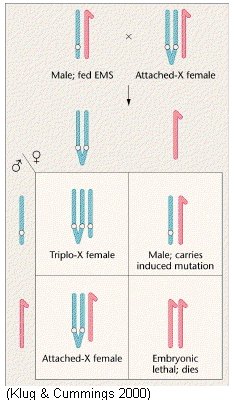
Phototaxis - normal flies are +vely phototactic, mutations are induced
in males with EMS and mated with attached-x virgin females; all male progeny
exhibiting abnormal behr were isolated
3 mutants were identified:
i. runner mutants - move quickly to and from light
ii. -ve phototactic mutants - move away from light
iii. nonphototactic mutants - show no preference
Conclusion: x-linked
recessive mutation Fig 24.13
Where within the fly must gene expression
occur to produce normal phototaxis (+ve)?
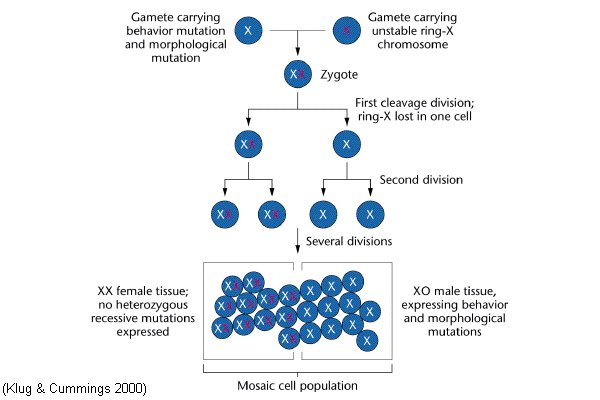
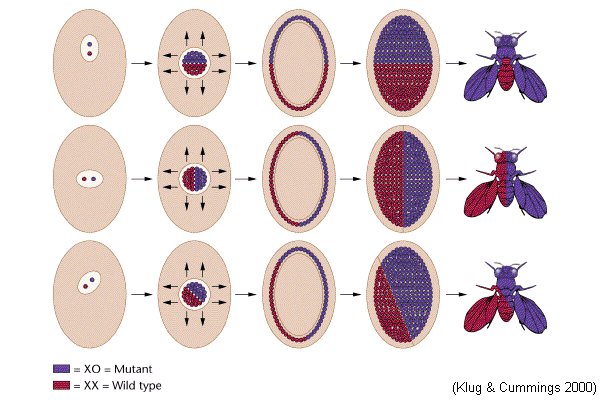
mosaic: some tissues are mutant, some tissues
are wild type
(used to find primary focus of abnormal behr)
To produce mosaic flies... Fig
24.14
*when and where the ring-x is lost in development determines
the pattern of mosaicism Fig 24.15
Conclusion:
The focus of the abnormal behr was found
to be the eye itself (normal body, mutant eyes = abnormal behr; one mutant
eye, one normal eye = unusual behr)
A large number of genes affecting behr in Drosophila have been identified and analyzed (see Table 24.4).
(B) Neurogenetics ( Fig
24.16 )
Two classes of mutants were identified:
i. paralytic
- temperature sensitve allele (defect in Na trasnport associated
with conduction in nerve impulses)
ii. shaker
- defect in K transport
Cloned Drosophila genes have been used as probes to isolate human ion channel genes (e.g. cardiac arrythymia)
(C) Learning in Drosophila
Classical Conditioning (pairing of odor and shock; CS-US...)
Selecting Mutants - mating mutagenized wild type males and normal wild
females yield learning mutants (e.g. amnesia
mutants)
All mutants so far are x-linked.
Linkage between cAMP and learning (e.g. rutabaga)
6. Behavior Genetics in Humans.
Two problems: i.
hard to define
ii. environmental factors
"human behavior has thus become a happy hunting ground for literary amateurs. And the reason is that psychology and genetics whose business it is to explain behavior have failed to face the task together."
Genetic Disorders
caused by single genes:
i. Huntington's
Disease - affects the nervous system, resulting in gradual loss of motor
fxn and coordination
ii. MAOA - mental
retardation and aggressive behr ( Fig 24.17
)
iii. Lesch-Nyhan Syndrome - mental and
developmental retardation and uncontrolled self-mutilation
iv. Tay-Sachs Disease - severe mental
retardation
v. PKU - unless treated results in mental
deficits
Multifactorial Traits: (G-E)
i. Manic Depression
ii. Schizophrenia
iii. Alcoholism...
- addictions like
alcoholism are multifactorial
disorders
- twin studies have
established that the role of genetic variation is profound, however twins
with the same genotype often do not share the same behavior (gene-environment
interaction)
- features of addiction:
1. compulsive drug seeking
2. use despite negative consequences
- genetic variation
has been related to the severity of addiction
- the severity of
additive symptoms is correlated
with an increased likelihood of multiple drug use
- alcoholism is
the most prevalent
addiction across cultures and generations
Comorbidity of Addictive Disorders
Addictive disorders
are closely associated
with:
1. other substance dependencies (e.g. more than 80% of alcoholics smoke
cigarettes)
2. other psychiatric disorders (e.g. severe alcoholism and suicidality
and impulsivity tend to co-exist)
Common and Distinct Neurobiologic Effects of Addiction to Alcohol
- Addictive substances
affect many of the neurotransmitter systems in the brain
- One pathway, the
mesolimbic dopamine
system, seems to be vital to the action of all addictive substances
(suggested brain reward mechanism)
- This pathway is
associated with feeling pleasure; psychostimulant such as alcohol exert
a primary reinforcing effect
by inducing the release of dopamine
- Continued reinforcement
is mediated by the psychostimulants which block the binding of dopamine
(DA antagonists)
to its transporter and by interacting with many dopamine receptors, including
D1, D2, and D3
note: ethanol has
an effect on a variety of targets within the cell membrane (e.g. neurotransmitter
membrane receptors, ion channels and neurotransmitter release)
The Heritability of Addictive Disorders
- Addictive diseases,
such as alcoholism are familial. Therefore a family history of alcoholism
would indicate a strong risk factor for the development of alcoholism for
someone in that family.
- Twin
studies and adoption
studies demonstrate that genetic factors are useful for determining vulnerability
especially to more severe forms of alcoholism.
- The heritability
of alcoholism was observed to be 0.38 in
one meta-analysis.
Note: the genetic
component of severe early-onset alcoholism appears to be a great deal more
than that of late-onset alcoholism.
Genetic Heterogeneity
It is possible that genetic characteristics may be shared by addicted individuals, but individual differences indicate that there are other influences/factors for addictions.
For alcoholism, variation
exists in...
1.
Prevalence - high vs. low in certain groups
(e.g. low in Muslim and Mormon groups)
2.
Presentation
- from long-term, heavy, daily drinking to episodes of heavy drinking
3.
Severity - amount
of dependence (psychological vs. physical)
4.
Sequelae
- behavioral
and psychiatric - physical
5.
Associated disorders
- MD, bulimia, etc.
Because of the complexity
of its causation, it is speculated that the genetic factors within individuals
will also vary. (i.e. addictions are under the control of many genes on
several chromosomes)
Moreover, the phenotypic
expression of addiction is largely due to environmental interactions.
Determining the Genetic Basis of Addictions
*large samples are needed in order to determine the smallest genetic effects*
4 Methods:
1. Linkage
analysis - inheritance pattern from pedigrees
2. Allele
sharing methods - comparison of affected relatives
to detect excess genotype sharing
3. Association
studies
- comparison of unrelated affected
and unaffected individuals
4. Analysis
of inbred, transgenic, and gene-knockout animals
(mice and rats)
- mapping of quantitative trait loci (determined by multiple genes responsible
for the addiction)
Genetic Studies of Addictive Disorders in Humans
Clinical Subgroups:
Alcoholics are classified into more homogeneous
groups by the factors that distinguish variations.
Electrophysiologic
Markers:
e.g. low resting brain activity is 3x more common in alcoholics than non-alcoholics
Alcohol Sensitivity:
e.g. lower hormonal response to modest dose of alcohol predicted a fourfold
increase in the risk for future alcoholism in young men independent of
family history.
Neurochemical Markers:
e.g. studies show that low platelet MAOB activity might be a marker for
alcoholism (particularly early onset, severe alcoholism in men)
e.g. several case studies have found lower adenylate cyclase activity in
the platelets and lymphocytes of alcoholics and in the brains of postmortem
alcoholics
Protective Genes:
The only genes for alcoholism identified are "protective" (e.g. ADH2,
ALDH1, ALDH2)
Upon the ingestion
of alcohol, causes the unpleasant effects (hangover
etc.). This is accomplished by decreasing the rate of metabolism of acetaldehyde,
thus increasing levels of acetaldehyde in the body. This is a toxic component,
hence the unpleasant effects.
Therefore, these genes are an inborn
model of protection from alcoholism.
Whole-Genome Linkage
Scans:
Two studies have identified linkage of alcoholism to chromosome regions:
1. Southwestern
Native American population:
- chr. 11p. (near the DRD4 dopamine receptor and tyrosine hydroxylase genes)
- chr. 4p. (near a GABAa receptor gene cluster)
2. Evidence for
linakge to chromsomes 1 and 7
*both studies found
a little evidence for on chr. 4q at the location of the alcohol dehydrogenase
gene cluster.
These are just the basics of this field. Many studies, taking advantage of techniques like PCR that we have already discussed in this course, have been carried out of late. For a more detailed look at them and their respective findings please stay tuned...