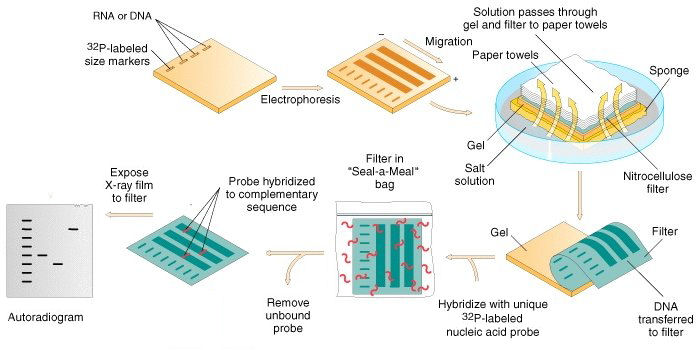
Analysis of DNA by the Southern Blot technique
Analysis of DNA by the Southern Blot technique
DNA is applied to an agarose gel, and electrophoresis separates the fragments of DNA according to size. The gel is placed atop a sponge in a dish of salt solution. A nitrocellulose membrane is placed on top of the gel. A stack of absorbent material (paper towels, borrowed from the washroom) is placed on top of this stack.The absorbent material draws the salt solution from the dish into the wick, and through the gel by capillary action. The DNA fragments are drawn into and caught in the nitrocellulose membrane. The procedure is called a "Southern transfer" or "blot" after the scientist who invented the procedure. The filter now contains the DNA fragments in the same pattern as the gel. [Alternatively, a block is placed in the dish, overlain with a piece of Whatman filter paper, overlain with the gel. The filter paper wicks the salt solution into the gel. The stack of paper towels is weighted with a glass plate, to keep them from swelling].
The filter is baked to dryness, then placed in a standard kitchen "Seal-a-Meal" bag that contains a solution of radioactively-labelled DNA probe [~~~~~] complementary to the gene sequence of interest. The DNA is denatured to separate the strands, and the probe binds to the filter only where a complementary DNA sequence is located. After washing to remove unbound probe, a piece of X-ray film is placed over the hybridized filter and exposed for several hours to several days. The radioactive label produces a black band on the film where it has stuck to the complementary DNA, producing an autoradiogram. If a labelled size marker (a "ladder") has been used, the exact sizes of the fragments can be determined. In other applications, the simple presence of a band in some lanes but not others provides the necessary data.
The Southern Blot
technique is useful for identifying a DNA sequence that
appears only once or twice in the genome, the typical situation
with diploid nuclear loci. Note that in this example, the
electrophoresis gel shows a continuous "smear" of DNA
of all fragment sizes, whereas the autoradiogram identifies
exactly three fragments, of three different sizes.
NB:
"Southern Blot" separation of DNA was
named for the scientists who invented the process, Eric Southern.
A similar process of separation and detection of RNA fragments
was dubbed a "Northern Blot", on the notion that
North & South like RNA & DNA are
"opposites." Not to be outdone, "Western"
and "Eastern" blots were developed as methods of
separating and detecting Proteins, and the "Northwestern"
blot combines Northern and Western blots in the same experiment.