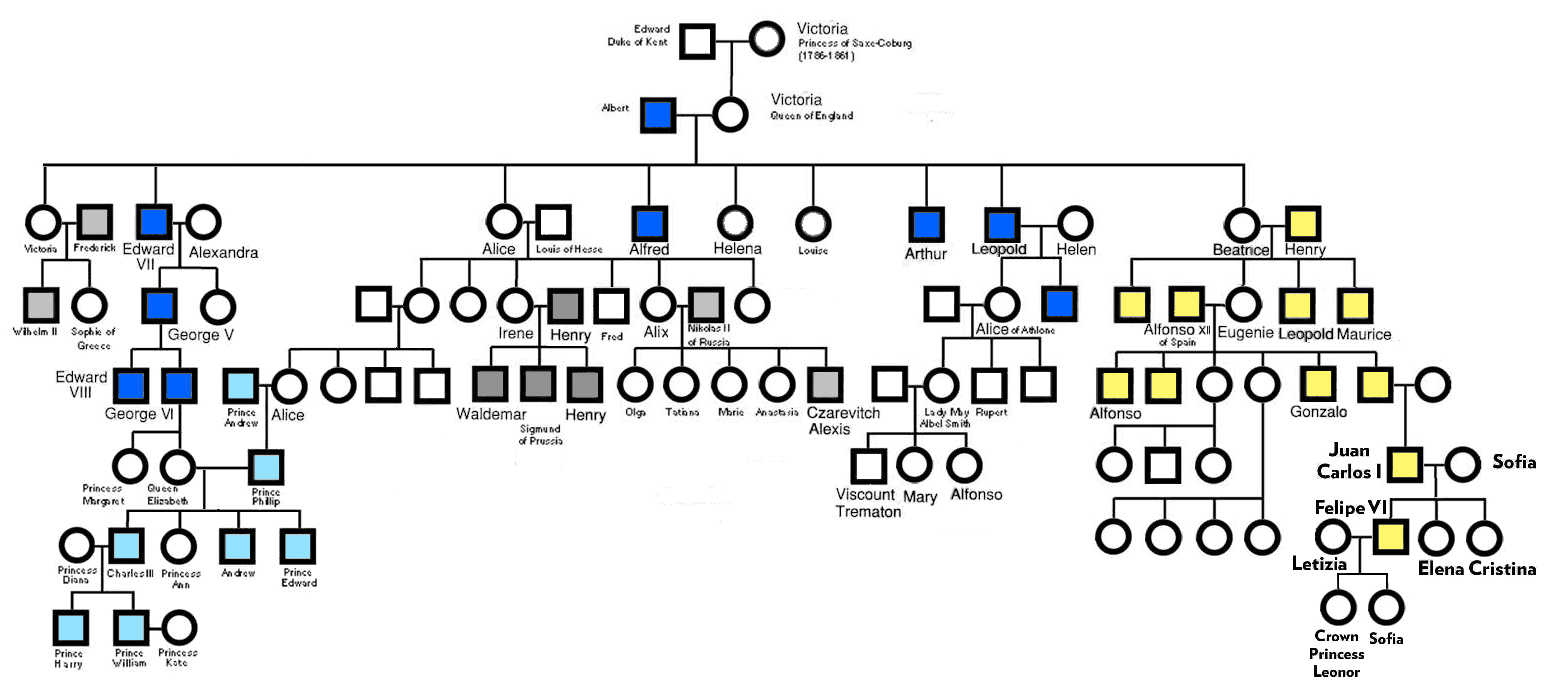
Pedigree analysis of yDNA in the descendants of Prince Albert, consort to Queen Victoria
Queen
Victoria's sporadic mutation for a Hemophilia
A allele is well-known. She had no Y Chromosome,
but the same pedigree offers the opportunity to examine the
passage of Prince Albert's yDNA among
male members of the royal families of Europe and other
descendants.
yDNA is passed solely from father to son. Albert and Queen Victoria had nine children, four of whom were sons capable of passing his yDNA to the next generation. However, only two of these sons had male offspring, and Leopold's (III-11) son had no offspring. Victoria's heir, King Edward VII (III-3) passed it to three Kings in the British royal family, his son George V (IV-3) and grandsons Edward VIII (V-1) and George VI (V-2). The last had two daughters (including Queen Elizabeth) but no sons, thus Albert's yDNA line ended after two more generations. Sons in the present royal family of the United Kingdom takes their yDNA from Prince Philip (VI-3), including Charles III (VII-2), his heir Prince William (VIII-2), and Williams heir, Prince George (not shown).
The Spanish royal family has its yDNA from Henry (III-14), husband of Victoria's youngest child, Beatrice. The yDNA is passed to Emeritus King Juan Carlos I (VI-10) and then to the present King Felipe VI (VII-11). As with Britain's George VI, he has two daughters including the heir apparent, Leonor, and no sons.
Homework: in the pedigree above,
(1) How many of the individuals with Albert's yDNA simultaneously carry at least one copy of Queen Victoria's Hemophilia A allele?
(2) Is the distribution of yDNA in the pedigree affected by the Hemophilia A allele, or by mtDNA?
(3) Compare and contrast the fates of Albert's, Henry's, and Philip's yDNA lineages. What makes the difference in generational longevity?
(4) Research Prince Philip's male ancestry. Does his yDNA lineage intersect with any of the others shown here?
yDNA is passed solely from father to son. Albert and Queen Victoria had nine children, four of whom were sons capable of passing his yDNA to the next generation. However, only two of these sons had male offspring, and Leopold's (III-11) son had no offspring. Victoria's heir, King Edward VII (III-3) passed it to three Kings in the British royal family, his son George V (IV-3) and grandsons Edward VIII (V-1) and George VI (V-2). The last had two daughters (including Queen Elizabeth) but no sons, thus Albert's yDNA line ended after two more generations. Sons in the present royal family of the United Kingdom takes their yDNA from Prince Philip (VI-3), including Charles III (VII-2), his heir Prince William (VIII-2), and Williams heir, Prince George (not shown).
The Spanish royal family has its yDNA from Henry (III-14), husband of Victoria's youngest child, Beatrice. The yDNA is passed to Emeritus King Juan Carlos I (VI-10) and then to the present King Felipe VI (VII-11). As with Britain's George VI, he has two daughters including the heir apparent, Leonor, and no sons.
Homework: in the pedigree above,
(1) How many of the individuals with Albert's yDNA simultaneously carry at least one copy of Queen Victoria's Hemophilia A allele?
(2) Is the distribution of yDNA in the pedigree affected by the Hemophilia A allele, or by mtDNA?
(3) Compare and contrast the fates of Albert's, Henry's, and Philip's yDNA lineages. What makes the difference in generational longevity?
(4) Research Prince Philip's male ancestry. Does his yDNA lineage intersect with any of the others shown here?
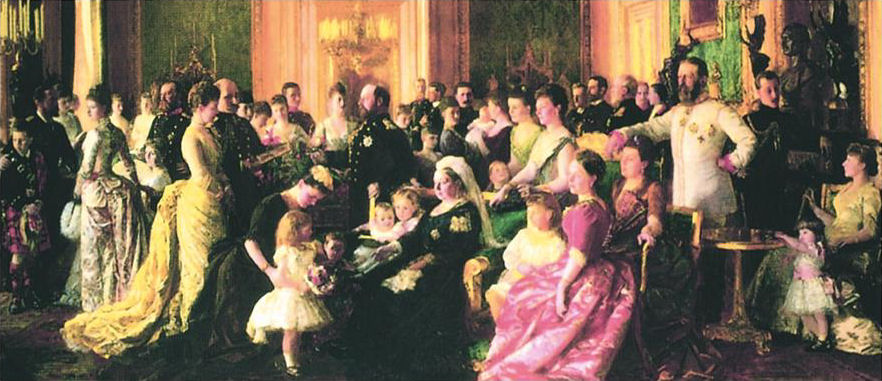
Queen Victoria and her extended family. She sits at centre, with her grandchildren in her lap.