2. Explain the phenomena illustrated in Fig. 22.20 of Klug & Cummings (2000) in terms of Gap, Pair-Rule, and Segment Polarity genes. [Fig. 20.21 in older edition].
Questions on Classic Papers
3. Garrod (1902) reports many observations, but no experiments. Suggest some experiments that Garrod might have done to test his hypothesis that Alkaptonuria is an “autosomal recessive” mendelian trait (bearing in mind that its 1902).
4. Beadle & Tatum (1941) provide evidence that nutritional mutants in haploid Neurospora are due to inability to synthesize particular biochemical substances (for example, Vitamin B6). What genetic experiments with Neurospora could Beadle and Tatum have done to demonstrate that these heterotrophs are in fact due to recessive mutations at single genes?
5.
The Hershey & Chase (1952) experiment
has been described as being “biochemically dirty” in that the results are
not absolutely clean-cut. Identify some of the results that are less than
clearn-cut. In Table I and Figure 1 of the experiment,
what
numerical results would you expect to obtain if all phage protein material
remained outside, and all phage nucleic acid went inside the bacterial
cells?
[See http://www.mun.ca/biology/scarr/Sensitization.html
for Table 1 and http://www.mun.ca/biology/scarr/Removal.html
for
Figure 1]
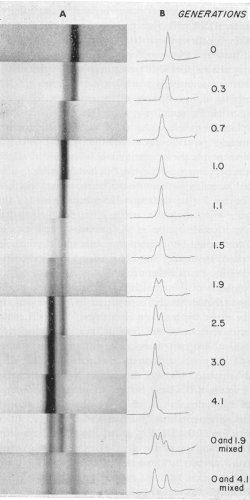
6. Meselson & Stahl (1958) use density gradient centrifugation to demonstrate DNA banding patterns that were consistent with the semi-conservative mode of replication of DNA. Sketch the results that would be expected if DNA replication were (1) conservative, or (2) dispersive. [Hint: at what stage of the original experiment can the conservative and dispersive models be ruled out? Explain]. [See http://www.ucs.mun.ca/~v66bmh/UVabs.jpg ] [larger version of results]
7.
Gene Regulation: Answer questions 6 & 7 in Chapter 15 (p.
428) of Klug & Cummings (2000)
[= questions 6 & 7 in Chapter 18 (p. 541) of older edition]
For the four genotypes indicated
below, explain (briefly) the associated phenotype in
terms of the lac operon model.
| Genotype | Lactose present | Lactose absent |
| I+O+Z+ | + | - |
| I+O+Z- | - | - |
| I-O+Z+/ F' I+ | + | - |
| I+O+Z+ / F' I- | + | - |