Intercalation of Base Analogs
Intercalation of Base Analogs
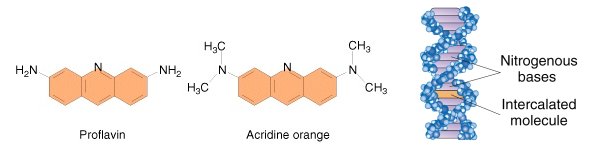
Acridine dyes resemble an AT or GC base pair in being planar with three rings. If these base analogs slip into the DNA molecule between two adjacent base pairs, the intercalated molecule may cause DNAPol to "stutter" and copy the molecule as an extra base pair. This introduces a frameshift mutation. Ethidium bromide is another base analog widely used in molecular biology as a stain for DNA: the intercalated molecule fluoresces on exposure to ultraviolet light.