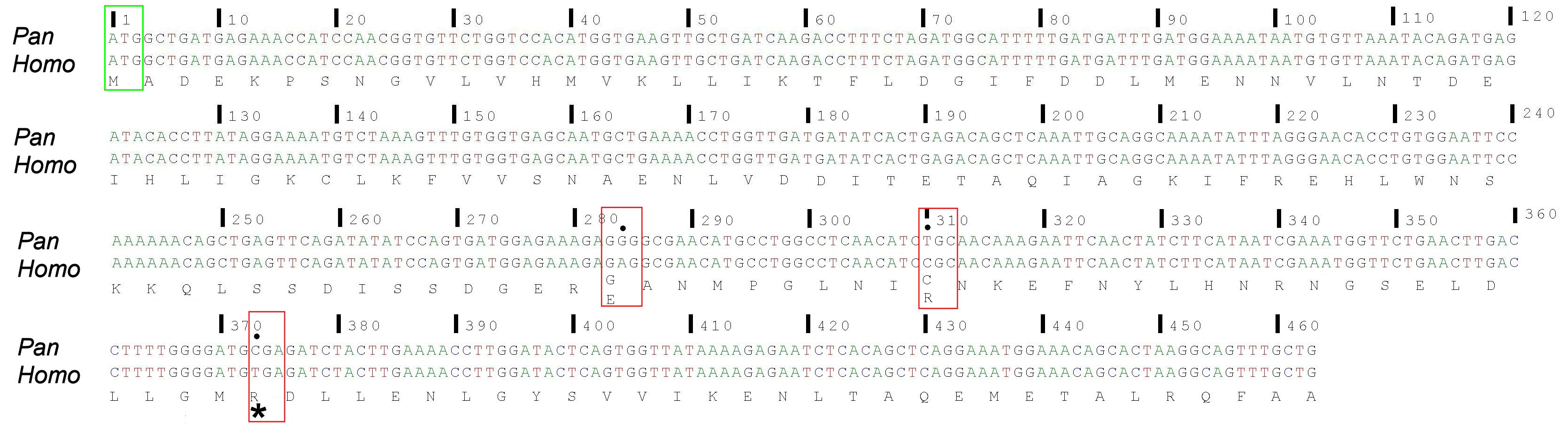
Functional CASP12 gene variation between Great Apes & Humans
Caspases are a family of cysteine-rich
proteases that cleave C-terminal aspartic acid (R)
residues in target proteins. Caspase-12 is
encoded by the CASP12 locus. Comparison with
other Great Apes shows a functional 1,689
bp gene in Chimps (Pan), but a premature
termination SNP at nucleotide position 373
[CGA
 TGA]
in most Humans (Homo). Note the 1st- &
2nd-position substitution mutations in two other
triplets. Loss of Caspase-12 function is
implicated in Alzheimer Disease in humans. In
some African populations, a reverse "back"
mutation creates a functional, "read-through"
allele, which is associated with an impaired
immunological response to endotoxins in food. This can
result in severe blood poisoning (sepsis).
TGA]
in most Humans (Homo). Note the 1st- &
2nd-position substitution mutations in two other
triplets. Loss of Caspase-12 function is
implicated in Alzheimer Disease in humans. In
some African populations, a reverse "back"
mutation creates a functional, "read-through"
allele, which is associated with an impaired
immunological response to endotoxins in food. This can
result in severe blood poisoning (sepsis).
HOMEWORK: One hypothesis is that evolution of the loss-of-function mutation in the human CASP12 gene relative to that in Great Apes confers a short-term advantage by mediating an improved immunological response, balanced against a longer-term disadvantage from susceptibility to Alzheimer disease in older humans. Chimps typically live shorter lives than humans. Evaluate this hypothesis, taking into consideration the genetic variation, difference in immunological response, and susceptibility to Alzheimer Disease.
TGA]
in most Humans (Homo). Note the 1st- &
2nd-position substitution mutations in two other
triplets. Loss of Caspase-12 function is
implicated in Alzheimer Disease in humans. In
some African populations, a reverse "back"
mutation creates a functional, "read-through"
allele, which is associated with an impaired
immunological response to endotoxins in food. This can
result in severe blood poisoning (sepsis). HOMEWORK: One hypothesis is that evolution of the loss-of-function mutation in the human CASP12 gene relative to that in Great Apes confers a short-term advantage by mediating an improved immunological response, balanced against a longer-term disadvantage from susceptibility to Alzheimer disease in older humans. Chimps typically live shorter lives than humans. Evaluate this hypothesis, taking into consideration the genetic variation, difference in immunological response, and susceptibility to Alzheimer Disease.
Figure & text ©2026 by Steven
M. Carr