Autoradiography of
biomolecules
Autoradiography is
a class of techniques in which biomolecules are
labelled with radioisotopes, such that their
presence can be detected in an autoradiogram ("self-picture").
Radioisotopes such as 14C, 32P,
and 35S emit radiation that exposes
photographic or X-Ray film. Substitution of 32P
into the phosphate backbone of DNA, or 35S
into the sulfur-containing amino acids of protein
allows labelled molecules to be detected.
In the particular
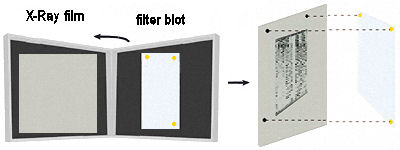
experiment shown, a DNA sequencing gel is dried onto
filter paper, the paper is
placed inside a light-proof X-Ray cassette
box (left), and overlain with a sheet of X-ray film. The cassette is sealed
shut and the exposure left for several hours to
several days. The film records the
positions of the radio-labelled DNA termination
fragments. In the
example, the DNA
sequencing "ladder" is read directly from
the autoradiogram.
In other applications, a radio-isotope labelled Southern
Blot filter DNA exposes the film, which when
developed shows a pattern of black bands that indicate
the presence or absence, and the sizes of labelled DNA in the blot. Alignment marks in three of
the four corners are made with radio-luminescent ink
that also exposes the film. The blot can be
aligned with the film by means of the three index marks.
[With three marks, only one alignment is possible] In
related experiments, the alignment can be used to locate
particular DNA bands
at precise positions on the blot, which can then be
recovered for
further experiments.
All text material ©2026 by Steven M. Carr