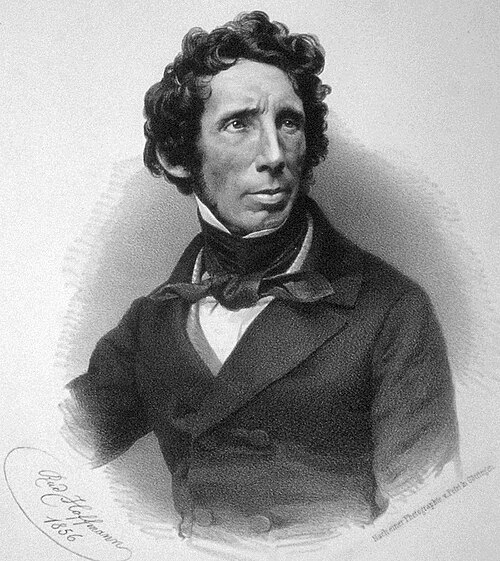
Friedrich Wöhler (1800 – 1882)
Friedrich Wöhler (1800–1882) was a German chemist whose laboratory synthesis of urea helped transform the relationship between chemistry and biology. He studied medicine at Heidelberg and earned his medical doctorate in 1823. He then studied with Jöns Jacob Berzelius in Stockholm. After appointments in Berlin and Kassel, he became professor of chemistry at Göttingen in 1836 and remained there throughout his career.
In 1828, Wöhler converted ammonium cyanate into urea, a nitrogenous substance that animals excrete in urine. The two compounds have the same elemental composition but different chemical structures. The experiment demonstrated that an in vitro laboratory reaction could produce an animal metabolic product, without an animal’s in vivo participation. The experiment is often presented as the textbook refutation of Vitalism, the claim that production of organic, carbon-based compounds by living organisms required a special “vital force” present only in living organisms. However, implications of the Urea synthesis did not end Vitalism at a stroke, but it did become an important landmark in organic chemistry.
Wöhler also made contributions to
inorganic chemistry and collaborated closely with Justus von
Liebig. Their studies of benzoyl compounds showed
how groups of atoms could retain their identity through
chemical reactions. His investigations also advanced methods
for the preparation of aluminum and other elements.
At Göttingen, he combined research with laboratory
instruction, and helped establish experimental chemistry as
a major university discipline.
Text material © 2026 by Steven M. Carr