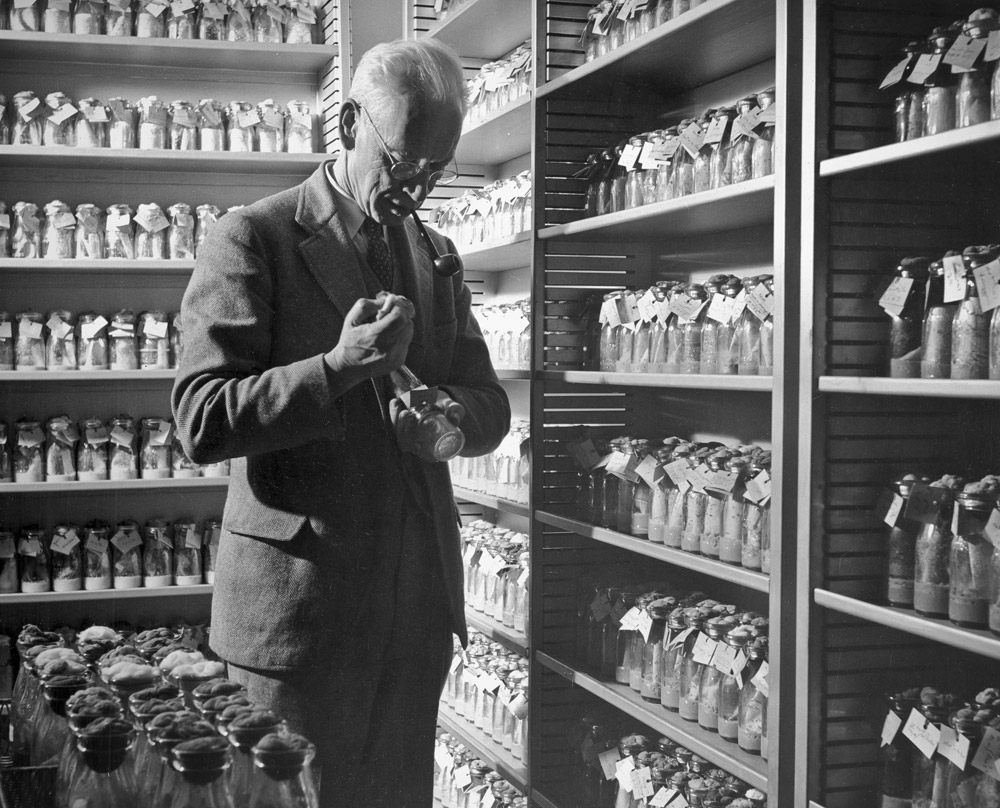
Alfred Sturtevant (1891 - 1970)
The "Fly Room" at Cal Tech, 1949
Alfred Henry Sturtevant (1891 – 1970) was an American geneticist whose first genetic map helped establish the chromosome theory of inheritance. In 1910, he joined Thomas Hunt Morgan’s laboratory at Columbia University as an undergraduate, alongside Calvin Bridges and Hermann Muller. In 1913, he published the first genetic map, which described the positions of genes on the X chromosome of Drosophila melanogaster. Whereas Mendel had advocated the principle of Independent Assortment of gene loci, Sturtevant showed that the gene loci could co-occur on the same chromosome, and that measurement of recombination frequencies could reveal the order and relative distances of genes along a chromosome. In 1914, he received his doctorate from Columbia.
In 1925,
Sturtevant demonstrated unequal crossing over at the Bar
locus, and he showed that a gene’s chromosomal position
could affect its expression. In 1928, he moved with Morgan
and Bridges to the California Institute of Technology, as
Professor of Genetics. His research extended across
developmental genetics, chromosome evolution, and Drosophila
taxonomy. With Theodosius Dobzhansky, he used
chromosome inversions to trace evolutionary relationships
among fruit-fly populations. He also helped establish the
principles of genetic fate maps, which connected
patches of tissue in the embryo with their adult organs.
His 1965 A History of Genetics
drew on his firsthand knowledge of the discipline’s early
development.