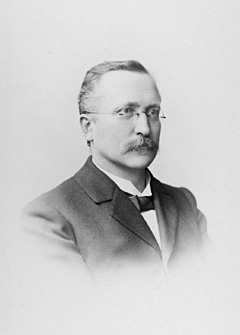
Wilhelm Roux (1850–1924)
Wilhelm Roux (1850–1924) was a German anatomist and embryologist who helped establish experimental embryology and developmental mechanics. He studied medicine at Jena, Berlin, and Strasbourg, where his teachers included Ernst Haeckel and Rudolf Virchow. In 1878, he received his doctorate at Jena. His anatomical interests led him toward broader questions of how do physical and biological processes produce the forms of organisms He became a principal architect of Entwicklungsmechanik, or developmental mechanics, which sought causal explanations for embryonic development through experiments rather than description alone.
In 1888, Roux published his famous experiments on early frog embryos. When one cell of a two-cell embryo was killed with a hot needle, he observed that the remaining cell often produced an approximate half embryo. Roux interpreted this as evidence that the one-cell embryo already possessed distinct regional developmental fates, so as to resemble a mosaic of individual developmental programs. His interpretation was challenged by the experiments of Hans Driesch, in which sea urchin embryos separated at the two-cell stage developed as complete, smaller larvae. The experiments differed in both organism and method: where Roux's procedure left the dead cell joined to its living partner, the altered the developmental environment of the remaining cell. The contrast left open the question of how much a cell’s fate depends on its internal constitution, and (or) its relations with other cells.
Roux founded the
Archiv für Entwicklungsmechanik der
Organismen in 1894, which gave
experimental embryology a journal and a scientific
identity. He defended physical and chemical processes as
sufficient explanations of development, versus Driesch’s
Neo-Vitalist claim that life required a special organizing
agency beyond those processes. Although his mosaic
interpretation could not explain embryonic development as
a whole, his insistence on experimental tests helped
transform the discipline. His strongest legacy lay in the
establishment of research program of experimental rather
than descriptive approach to development.
Text material © 2026 by Steven M. Carr