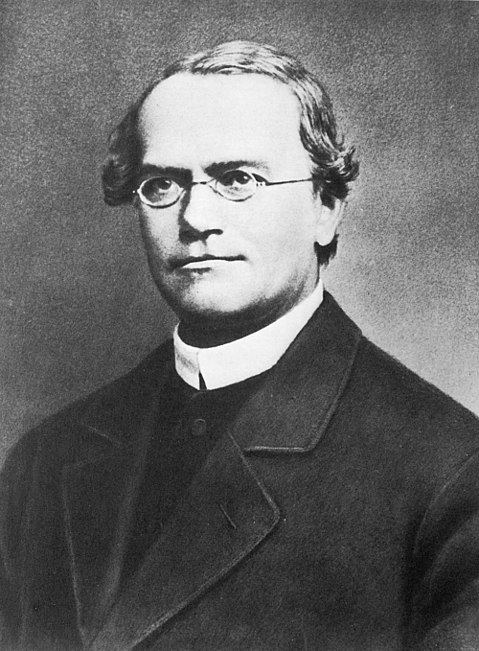
Gregor Mendel (1822 - 1884)
"The Father of Genetics"
Gregor
Mendel (1822–1884) was an Austrian monk and scientist
known as the "Father of Genetics". Mendel studied science and
mathematics at the University of Vienna, and joined
the Augustinian monastery in Brno, an institution known for
its interest in science.
Mendel conducted
experiments with Sweet Peas (Pisum sativa) during the
1850s and 1860s. By working with discrete characters such as
round and wrinkled peas, or yellow and green pea pods, and
white or red flowers, and by conducting carefully controlled
crosses over several generations, and most importantly,
counting the results of such crosses, he discovered predictable patterns
in how traits are inherited. He proposed that inherited
characteristics are controlled by discrete factors, which he
called elementen and which we now call genes, and developed principles that became
known as the Laws of Dominance,
Segregation and
Independent Assortment. Mendel published his
findings in 1867, but they received almost no attention during
his lifetime. He corresponded with a prominent German
scientist who failed to appreciate what he had done, and
directed him to work on precisely the wrong species to test
his theories. Mendel sent a copy of his paper to Charles
Darwin: Darwin never opened the paper.
Mendel
eventually became Abbot of his monastery, which curtailed his
experimental work. His students all recalled him as an
excellent teacher. Almost simultaneously at the beginning of
the twentieth century, three scientists rediscovered his 1867
paper and recognized the importance of his earlier work. This
launched an explosion of research in the new science of Genetics.
Mendel's experiments are appreciated as a landmark of
experimental design, careful procedure, and mathematical
analysis in biology.