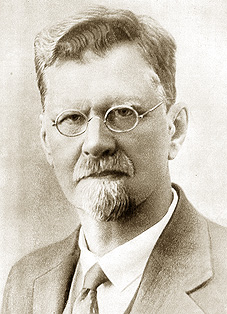
Sergei Sergeyevich Chetverikov (1880 - 1959)
Сергей Сергеевич Четвериков
Sergei Sergeyevich Chetverikov (1880 – 1959) was a Russian and Soviet biologist whose research helped unite Mendelian genetics with Darwinian evolution. He studied zoology at Moscow University, and from 1921 directed genetic research at the Institute of Experimental Biology in Moscow. He is best remembered for his 1926 paper, in which he argued that natural populations could harbor extensive genetic variation despite similarity of phenotype, because recessive alleles could persist in heterozygotes. He thus showed how Mendelian inheritance could supply the variation on which natural selection acts.This MS is regarded as one of the foundations of population genetics, but was little recognized at the time because it was written in the Russian language.
Following the lead of Morgan in the United States,
Chetverikov’s research group studied variation in natural
populations of Drosophila.
His ideas contributed to the evolutionary
synthesis through other Soviet scientists such as Nikolai
Timoféeff-Ressovsky and Theodosius Dobzhansky.
Soviet authorities arrested Chetverikov in 1929 and sent him
into internal exile. In 1935 he became head of genetics at
Gorky University. The official triumph of Trofim Lysenko’s
doctrines in 1948 once again forced him from his university
positions.