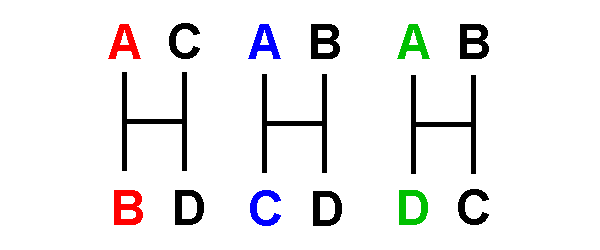
Among
four taxa A, B, C, & D, there are exactly three
hypotheses of relationship:
either A is most closely related to B, or to C,
or to D
(This statement covers all possible
relationships between the four taxa)
We want to evaluate
the hypotheses in the form of the Three-Taxon
Statement:
"X and Y are more closely related to each
other than either is to Z"
The
alternative hypotheses can be shown as networks with four branches
and an internode
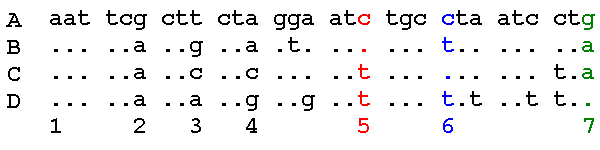
Types 1 - 4 are
uninformative:
They
give no information about relationships, because
all hypotheses require the same
number of changes [see HOMEWORK],
so
none is more parsimonious than the others.
Position 1 is invariant, and is the most
common type.
Position 2 requires a single change in one taxon,
in all hypotheses
Types 5, 6
& 7 are informative:
Two taxa share one state, other two
share another
They give information
about relationships,
because
one hypothesis requires fewer changes than the
other two
&
is therefore more parsimonious than the others
Position 5 indicates
that A & B are most closely related:
The first hypothesis explains
the distribution of SNPs with a single change,
the latter
two require two changes each
The first hypothesis
is a more parsimonious explanation of the data than the others.
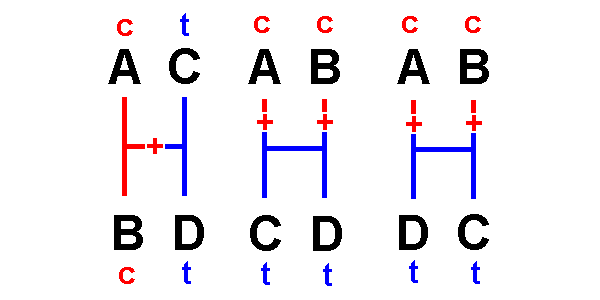
By the same logic:
Position 6 indicates
that A & C are most closely related.
Position 7 indicates
that A & D are most closely related.
Homework: 1) Explain why
Positions 2, 3, & 4 are uninformative.
(Hint: how many changes are required by each, for
the three hypotheses
2) For the three networks above, sketch the changes
required by sites of Positions 6 & 7