(click on item to view)

"A little sunlight is the best disinfectant." U.S. Supreme Court Justice Louis Brandeis

Environmental issues

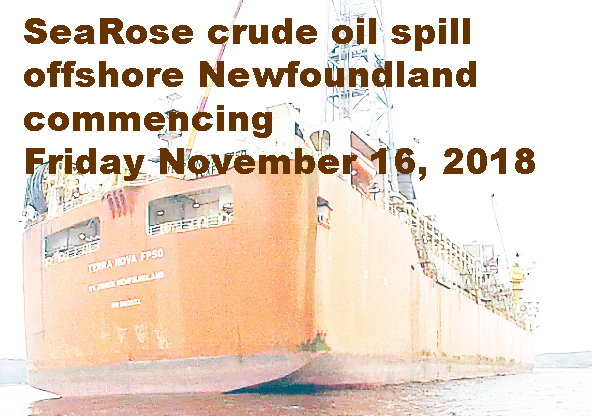
"A small quantity of oil spilled into the Atlantic Ocean Tuesday near a floating platform drilling off Newfoundland's southeast coast, the operator said."

"Key questions posed by ILJ and 'DFO science advisor' about a Newfoundland offshore oil spill response plan (and even if there is a plan) remain unanswered. Recent events (May 2011) are not cause for optimism that things will improve - see here."


"The Canadian government's short term response to the Nov 21 spill (i.e., to document ecological damage) was grossly inadequate."

"If offshore oil and gas activities are indeed exempt from Bill C-15, then seabirds and other migratory birds appear to have no clearly defined legal protection from harm from these activities."

"Canada's environmental policies related to preventing damage from offshore oil and gas extraction seem to be a product of negligence and incompetence."
 

• April 29, 2011 - CBC interview - Ian talks about the Turner report on offshore oil - download podcast NEW

• April 30, 2010 - CBC interview - Ian talks about response to an offshore oil spill in Newfoundland - view video

• May 3, 2010 - CBC Crosstalk - on response to an offshore oil spill in Newfoundland - download podcast


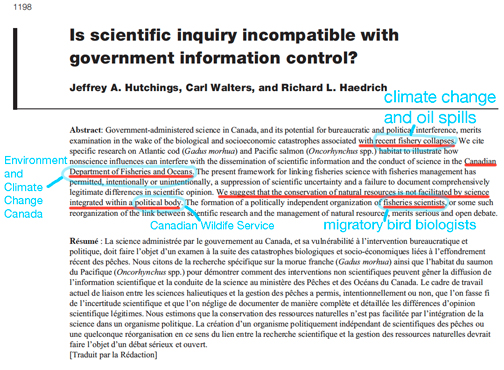
"Nonscience influences on fisheries research incompatible with normal scientific inquiry included (i) government denunciation of independent work, (ii) misrepresentation of alternative hypotheses, (iii) interference in scientific conclusions, (iv) disciplining of scientists who communicated publicly the results of peer-reviewed research, and (v) misrepresentation of the scientific basis of public reports and government statements."


The proposed pollution of two lakes in central Newfoundland (comments on EIS by John Gibson, retired DFO Research Scientist)

"Incredibly, it is stated in the EIS that 'the residual environmental effects of the project on fish and fish habitat are assessed as minor'." (Gibson's comments, pointing out GROSS ERRORS in the EIS, were ignored - underlining the degree to which the Canadian government will go to use pseudoscience to support government policy)

The Sandy Pond "compensation" (comments by John Gibson, retired DFO Research Scientist)

"The Departments of Fisheries and Oceans and of Environment have given permission for these waters to be destroyed under the auspices of Schedule 2 of the Metal Mining Effluent Regulations, a retrograde amendment made in 2002, allowing mining companies to destroy pristine lakes, under the condition that there be adequate compensation. The loss of Sandy Pond would result in major losses of habitat and biological diversity, and degradation of recreational opportunities. The proposed compensation is inadequate. In fact we believe the exercise is a public relations strategy, similar to the “compensaton” for the recent losses of Star Lake and Trout Pond. In general, we deplore the ability of corporation lobbying, for their economic advantage, to influence the mandates of federal Departments. The Department of Fisheries and Oceans should ensure conservation and enhancement of our fisheries resources for the benefit of the citizens of Canada, and resist attempts to sully their mandate."

The paucity of ethics in Canadian environmental affairs (Gibson, Gallagher and Haedrich - Osprey 38(4): 110-119. (Dec 2007))

"The proposed compensation for lost lake habitat by fluvial habitat in Harpoon Brook Steady is a sham because this habitat is presently fish habitat already , and in fact no new habitat is being created to compensate for that being destroyed... Two formerly pristine lakes have been turned into permanent toxic waste dumps, legalized by federal and provincial authorities, for the economic benefit of a mining company."

Dumping mining waste into water 'more responsible': fisheries minister (CBC News)

"Although the Fisheries Act prevents the disposal of harmful substances into fish-bearing waters, an inconspicuous subsection of the mining effluent regulations known as Schedule Two allows federal bureaucrats to redefine lakes as "tailings impoundment areas.""

Lakes across Canada face being turned into mine dump sites

"Something that used to be a lake, or a river, in fact, they can use rivers, by being put on this section two of this regulation is no longer a river or a lake," she said. "It's a tailings impoundment area. It's a waste disposal site. It's an industrial waste dump."


News media reported that Third Engineer Domingo Silva provided video evidence of his own ship dumping 30 tonnes of oily bildge off Newfoundland at around 8 pm on April 24, 2008. Meanwhile, Environment Canada biologists in St. John's only heard about the event via CBC news days later, and there was no Environment Canada action to check the dumping site for an oil slick or to conduct surveys to look for oiled and dead seabirds. Apparent timeline:

Saturday April 24 - 30 tonnes of oily bilge allegedly dumped off Newfoundland from the MSC Trinidad

Monday April 26 - MSC Trinidad arrives Montreal, five sailors contact the International Transportation Federation with allegations of illegal dumping and video evidence.

Tuesday April 27 - Transport Canada begins investigations, ship 'detained'.

Friday May 2 - Canadian Wildife Service biologists in St. John's Newfoundland find out about the alleged oil dumping from CBC news, Silva and other whistleblowers hussled back to Phillipines.

No charges laid (HOW CAN YOU HAVE NO CHARGES LAID WHEN THE FIRST MATE TURNS IN HIS OWN SHIP ALLEGING A 30 TONNE DUMP?)


Bill C-15: "An Act to amend the Migratory Birds Convention Act (1994), and the Canadian Environmental Protection Act (1999) will more effectively address enforcement issues in cases of marine pollution. The legislation will also provide clarity for enforcement officials, as well as owners and operators of vessels in waters under Canadian jurisdiction, including the 200-mile Exclusive Economic Zone. "Amending these essential pieces of environmental legislation will complement the Canada Shipping Act (2001) and allow for more cooperative enforcement actions," said Minister Anderson. "We are providing the judicial system with the tools to prosecute offenders and to enable fines that appropriately reflect the damages caused to the environment.""


The Canadian government's response to a spill of approximately 300 L of crude oil from the Hibernia platform on about January 29, 2006 suggests yes, they are exempt. Such small spills are thought to be responsible for the deaths of hundreds of thousands of seabirds each year off Newfoundland.

The Canadian government's BOAS (Birds Oiled At Sea) web page states the following: "Government agencies, industry, and the private sector have to work together as a unit to bring this to a halt. We can no longer tolerate the release of oil into our pristine marine environment resulting in the death and injury to thousands of seabirds. Narrator: We have the eyes, the ears, the technology... we have the will...each person, each department provides a vital piece of the puzzle... working together, we make a powerful team...working together, we will stamp out this unconscionable environmental crime. Our only effective long term solution is to prevent oil dumping in the first place. Canadians demand it... the world expects it.... the seabirds deserve it... because for them there's no second chance..".

Nevertheless, no charges were laid after the January 29 spill, which resembles 55 other recent spills from offshore oil platforms off Newfoundland. In contrast, a Newfoundland and Labrador provincial court judge ordered the Motor Vessel (MV) Nordic Fighter, a Norwegian-registered tanker, to pay a $70,000 penalty for accidentally discharging 64 Litres of oil off Placentia Bay on June 22, 2004 ($1,093.75 per litre spilled).


Stephen Harper: "This new technology, carbon capture and storage, when fully commercialized ... will collect carbon dioxide emissions from oilsands operations and coal-fired electrical plants and seal them deep underground."


"No significant effects on marine birds, during construction or
operations, were identified"


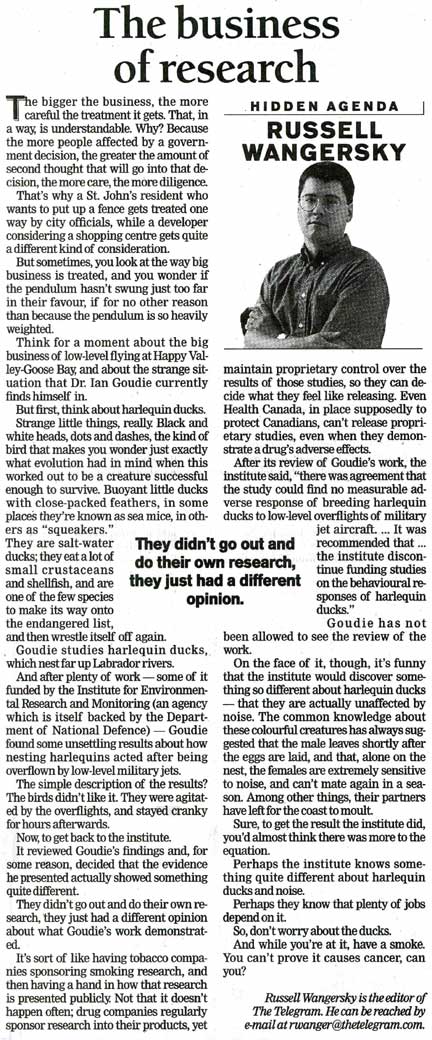
"The business of research - Hidden Agenda" (Telegram article by Russell Wangersky) (132k jpeg)

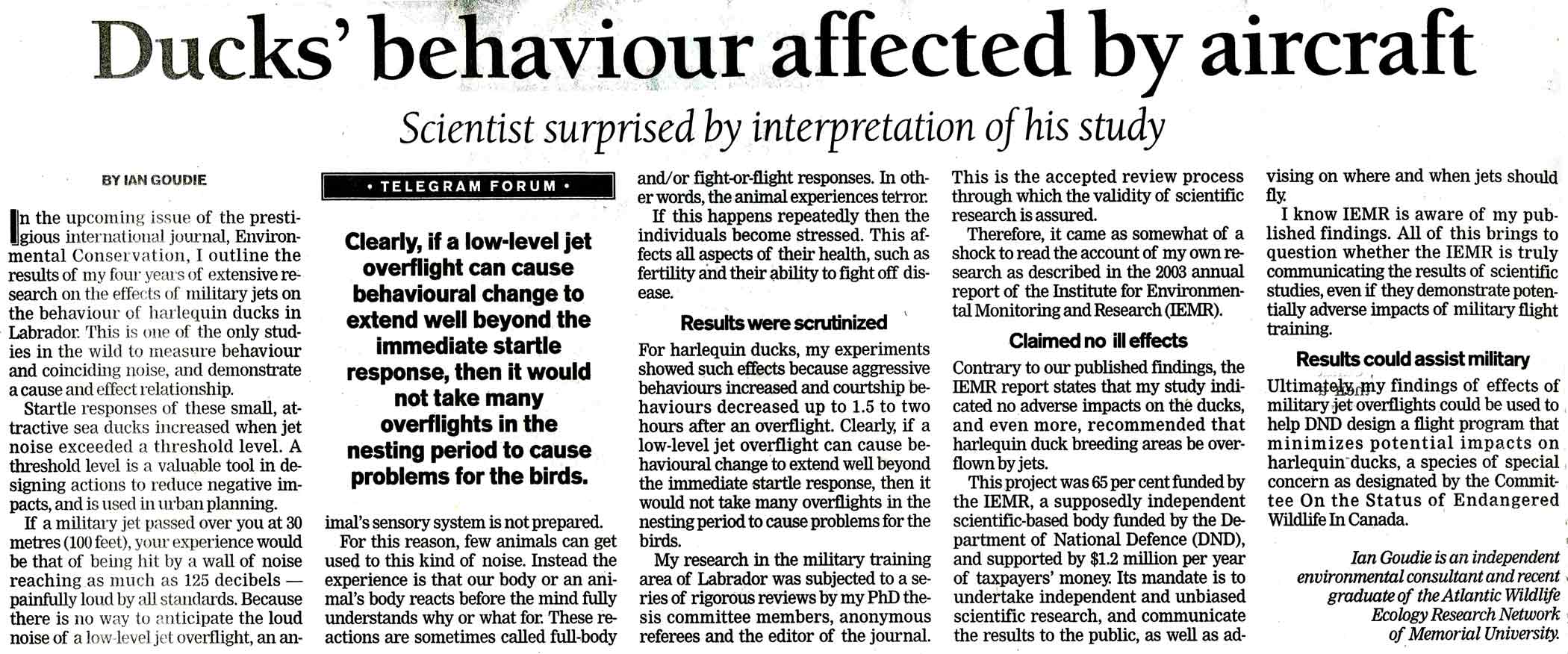
"Ducks' behaviour affected by aircraft - Scientist surprised by interpretation of his study" (Telegram article by Dr. R. Ian Goudie) (256k jpeg)

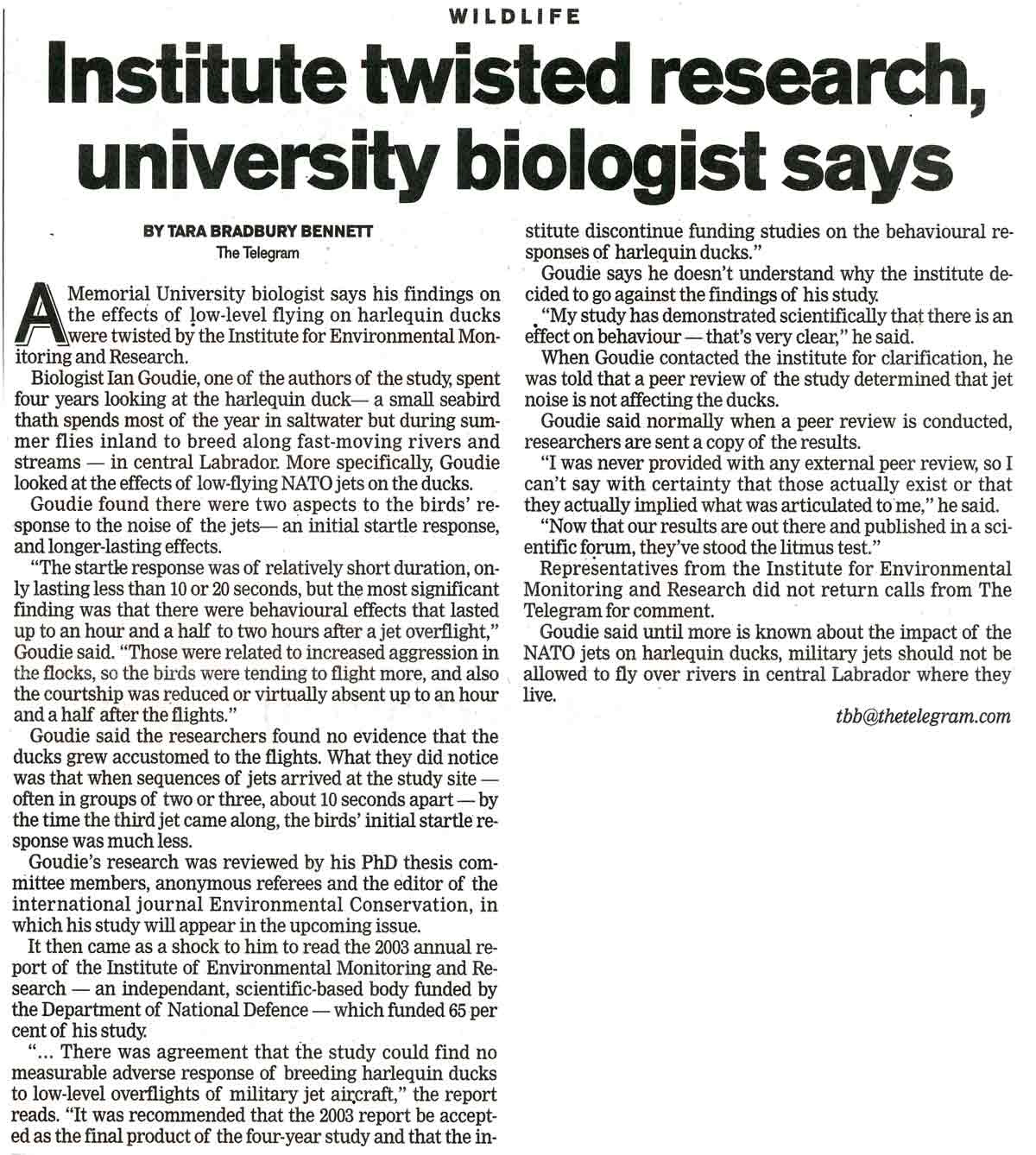
"Institute twisted research, biologist says" (Telegram article by Tara Bradbury Bennett) (172k jpeg)

"Harlequin Duck articles don't tell whole story" (Labradorian article by Louis Lapierre)

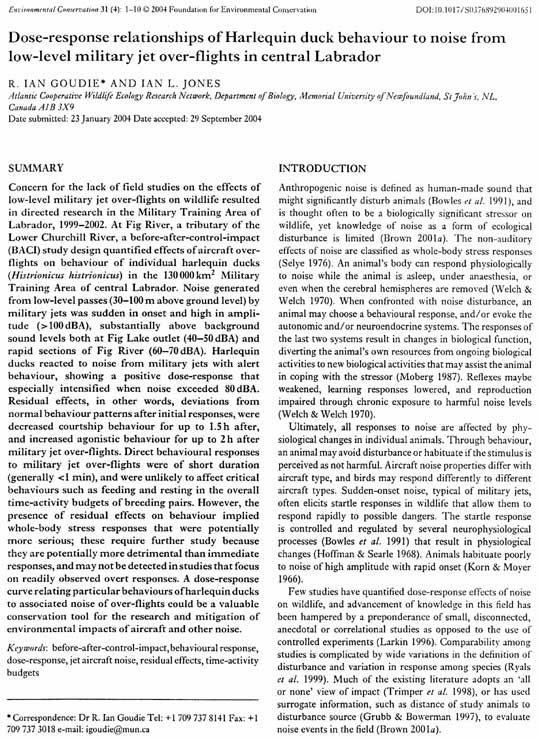
read the 2004 paper in Environmental Conservation by Goudie and Jones (112k .jpg file page 1 only) for complete article click here (4 MB)

read the IEMR's representation of the results of this published science (60k jpeg)

Canadian Forces Base Goose Bay "the poster boy for warped military spending"


""With a catch of 266,000 tonnes in 1988, the spawning stock should reach 1.16 million tonnes by the beginning of 1989."

DFO. 1988. The Science of Cod. Fo'c'sle 8 (2), p. 24


"Cod in this population are at historically low levels of abundance. The 3-generation rate of decline experienced by the Newfoundland and Labrador population was 97%"

COSEWIC status report update on Atlantic Cod May 2003


Atlantic Cod Gadus morhua

509,020 tonnes were landed in Atlantic Canada in 1983; their populations have been reduced by overfishing to less than 0.1% of former abundance off the NE coast of Newfoundland and the species is close to extinction, yet fishing continues and DFO has blocked listing of the species as Endangered under the Species at Risk Act.

Haddock Melanogrammus aeglefinus

In 1965, 249,000 tonnes were killed in Atlantic Canada; at present their population is reduced to less than1% of former abundance in Newfoundland and declining. Cause: overfishing promoted by the Canadian Department of Fisheries and Oceans.

"Cod not headed for endangered list: federal fisheries minister" (CBC, November 29, 2005)

"Scientists are certainly saying that they are at historic lows and they're not as abundant as they were. They're not dominant. There still remain a lot of cod, and, you know, it's not a situation where we think we have to list." (Federal Fisheries Minister Geoff Regan) Regan said the federal cabinet also considered the millions of dollars that would be lost in the fishing industry if cod was covered under the Species At Risk Act.

Current status of Northern Cod

"average biomass of cod in the offshore (2J3KL) over the last 3 years is 4-5% of the average during the 1980's. However, survey biomass has been increasing since 2003. There is a risk that fishing inshore will impede stock growth offshore. "

"Newfoundlanders and Labradorians have made it clear how important a recreational fishery is to them. Compliance in this fishery over the last two years has been good and I am pleased to announce a recreational groundfish fishery for all inshore waters around Newfoundland and Labrador again in 2008," stated Minister Hearn. "I look forward to having people from clear across the province take advantage of this opportunity to enjoy some time on the water."


Five Atlantic groundfish species driven to the brink of extinction (Nature, January 2006)

Roundnose Genadier, Onion-eye Grenadier, Blue Hake, Spiny Eel, and Spinytail Skate declined in abundance by 87 - 98% between 1975-1995 due to by-catch in trawl and other fisheries managed by DFO


"(in the northwest Atlantic) scalloped hammerhead, white, and thresher sharks have declined by over 75% in the past 15 years." Baum et al. 2003

Oceanic whitetip shark populations have plummeted by 99 per cent since the 1950s and the species is now nearly extirpated from the Gulf of Mexico- cause: OVERFISHING


"Worldwide, open net-cage fish farming industries use publicly owned coastal waters to support what are essentially intensive private feedlot operations that dump drug-laced sewage into the ocean. Governments looking for new opportunities in rural, economically depressed coastal areas often have encouraged the industry. But increasingly, citizens are questioning if any benefits are offset by the alarming array of environmental, social, economic and health costs."


"Don't Talk to the Police" by Professor James Duane (You-tube)

James Duane explains why innocent people should never talk to the police.


Ashkelon (formerly Ni'ilya)


STUDENTS AGAINST ISRAELI APARTHEID @ CARLETON UNIVERSITY

"It reminded me so much of what happened to us black people in South Africa. I have seen the humiliation of the Palestinians
at checkpoints and roadblocks, suffering like us when young white police officers prevented us from moving about.
Many South Africans are beginning to recognize the parallels to what we went through.
" --- Desmond Tutu


Official disclaimers: nothing in the contents of this site or its links should be taken to represent MUN policy; links to external sites are provided for education and research purposes, their inclusion here in no way implies that MUN or Marvin endorse the content or use of these sites.