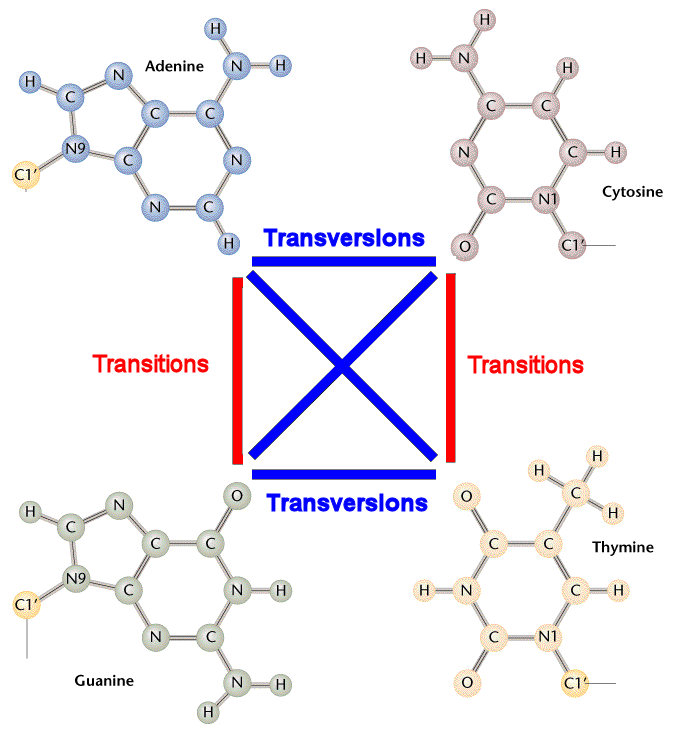
Transition versus Transversion mutations
DNA substitution mutations are of two types. Transitions are
interchanges of two-ring purines
(A  G),
or of one-ring pyrimidines (C T): they therefore involve
bases of similar shape. Transversions are interchanges
of purine for pyrimidine bases
or v.v., which
therefore involve exchange of one-ring
& two-ring structures.
G),
or of one-ring pyrimidines (C T): they therefore involve
bases of similar shape. Transversions are interchanges
of purine for pyrimidine bases
or v.v., which
therefore involve exchange of one-ring
& two-ring structures.
Although there are twice as many possible transversions,
because of the molecular
mechanisms by which they are generated, transition
mutations occur at higher frequency than transversions. As
well, transitions are less likely to result in amino acid
substitutions (due to "wobble"),
and are therefore more likely to persist as "silent
substitutions" in populations as single
nucleotide polymorphisms (SNPs).
 G),
or of one-ring pyrimidines (C
G),
or of one-ring pyrimidines (C