Primer
of Mendelian Genetics
The appearance of an organism (phenotype) is influenced by its
hereditary makeup (genotype).
Many individual characters or traits (morphological,
behavioral, biochemical, molecular, etc.) of organisms are
influenced more or less directly by individual hereditary elements
called genes. Genes are
located on chromosomes, each
at a particular physical location called a locus (plural, loci).
Genetics is the science of analyzing phenotypes to
infer the nature of their underlying genotypes. The
basic principles were first described by Gregor Mendel in
1867. Genetics operated as a distinct science after the rediscovery of
Mendel's work in 1900, without knowledge of the physical
hereditary material, until the discovery of DNA structure
in 1953. Genetics is distinct from molecular
biology, which analyzes genotypes (in a DNA
molecule) to predict phenotypes (which are often direct or indirect products of
proteins). For this reason, the so-called Central
Dogma of molecular biology (DNA  RNA
Protein) is sometimes called "reverse genetics."
RNA
Protein) is sometimes called "reverse genetics."
1. Alternative forms of genes are called alleles; every individual possesses
two alleles for each gene*.
An
individual with two identical alleles is called a homozygote and
is described as homozygous;
an
individual with two dissimilar alleles is called a heterozygote and
is
described as heterozygous.
2. Some alleles (called dominant)
'mask' the phenotypic expression of other alleles (called recessive).
Dominance is determined by comparison of the
heterozygous phenotype with that of the two homozygotes
Whichever of
the two homozygotes the heterozygote resembles most closely
determines the dominant allele
'Dominance' is a genetic relationship, unrelated to
frequency (common or rare) or phenotypic effect of the allele
Dominant
alleles are symbolized with a capital letter (A);
recessive
alleles are symbolized with a lower-case letter (a).
For
example: some people can taste the chemical phenylthiocarbimide (PTC) ("tasters"),
and some cannot ("non-tasters").
The character
"PTC
sensitivity" is influenced by a gene with
two alleles,
one
associated
with "taster" and one with "non-taster".
The "taster"
allele masks the expression of the "non-taster"
allele in heterozygotes:
Homozygous TT or
heterozygous Tt individuals both
show the "T" phenotype ("taster"):
only
a homozygous tt individual
show
the "t" phenotype
("non-taster").
Because the phenotype of the Tt individuals resembles
that of the TT individuals,
the T allele is
described as dominant to the t allele.
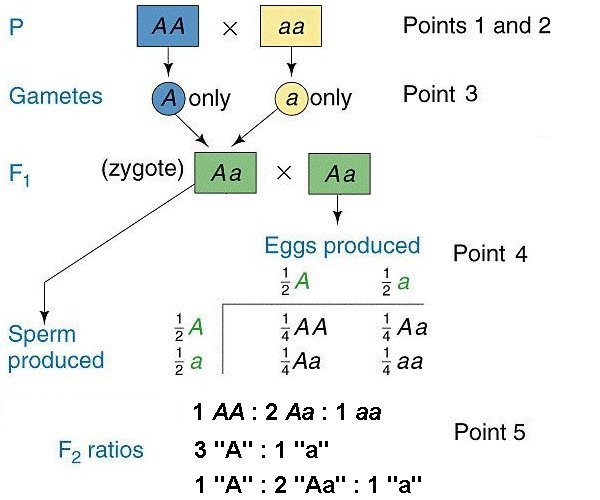
3. The two alleles separate (segregate) during the
formation of gametes (eggs
& sperm);
half
of the germs cells carry one allele & half carry the other [Mendel's
Law of Segregation].
4. Random union of gametes produces zygotes that develop into new
individuals.
Zygotic genotypes occur in characteristic ratios, according to the genotypes
of the parents.
For
example, a cross between two heterozygotes (Aa x Aa)
produces
an expected genotypic ratio of 1:2:1
among AA, Aa, & aa genotypes.
5. The genotypic ratios produce
characteristic phenotypic ratios,
according
to the dominance relationships
of the alleles involved.
For
example, if A is dominant to a, the cross between
heterozygotes produces
an
expected phenotypic ratio of 3:1
among "A" and "a" phenotypes.
6. Alleles at separate loci are inherited independently [Mendel's Law of Independent Assortment]
This produces characteristic
genotypic and phenotypic ratios among multiple loci.
For example, in
a dihybrid
cross between two "double
heterozygotes" ( AaBb
x AaBb )
The genotypic ratios are 1 : 2 : 1 : 2 :
4 : 2 : 1 : 2 : 1
for the genotypes AABB
AABb AAbb AaBB AaBb Aabb aaBB
aaBb aabb
and the phenotypic ratios are 9 "AB" : 3 "Ab" : 3 "aB" : 1 "ab"
*
Mendel
was unaware that genes reside on chromosomes
Genes that occur on the same chromosome are said to be linked
Gene loci located near each other on a
single chromosome will not assort
independently.
The characteristic ratios will be modified,
according to how close they are.
The
modified ratios can be used to create a genetic map of the
chromosome
For example, sex in humans is
determined by genes on sex chromosomes (X and Y)
females are XX
have two alleles (one on each X)
males are XY and
have only one allele on the single X (hemizygous)
Characters on the X (or Y) chromosomes are sex-linked