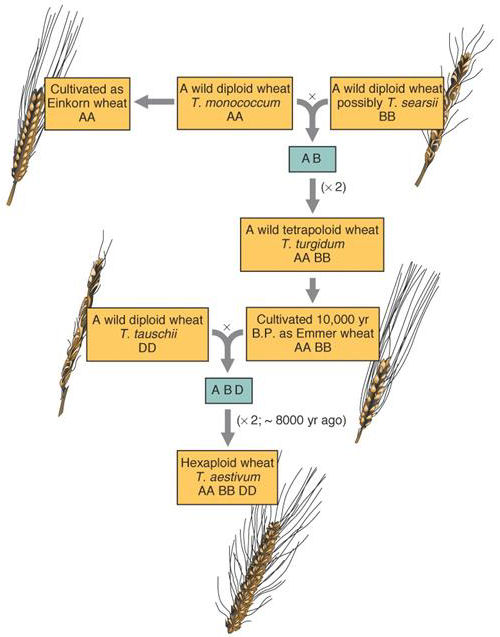
Origin of wheat as a hexaploid
The ancestor of
modern Wheat (Triticum aestivum) is believed to
be an interspecies hybrid
of two species of Triticum,
T. monococcum and T. searsi, which
contributed chromosome sets A
and B,
respectively.This lead to a stable autopolyploid tetraploid by
genome duplication, an AABB
plant that produces AB
gametes. A cross between this tetraploid an another
diploid species, T. tauschii
(chromosome set D)
produced an allopolyploid triploid (ABD), which again underwent
a genome duplication, and produced modern T. aestivum, a hexaploid with an AABBDD chromosome set. The
hexaploid chromosome set has become diploidized, which is to say that homologous
chromosomes in each of the A,
B, and D sets diverge genetically
from each other so that they behave separately during meiosis.
Triticale is a tetraploid hybrid of Wheat (Triticum) and Rye (Secale) that combines the desirable grain qualities of Wheat with the hardiness of Rye. In the Star Trek episode The Trouble with Tribbles, a main plot element is a supply of "Quadro-triticale" intended for use on a planet disputed by the Federation and Klingons. The "Quadro" may refer to further tetra-polyploidization
Triticale is a tetraploid hybrid of Wheat (Triticum) and Rye (Secale) that combines the desirable grain qualities of Wheat with the hardiness of Rye. In the Star Trek episode The Trouble with Tribbles, a main plot element is a supply of "Quadro-triticale" intended for use on a planet disputed by the Federation and Klingons. The "Quadro" may refer to further tetra-polyploidization