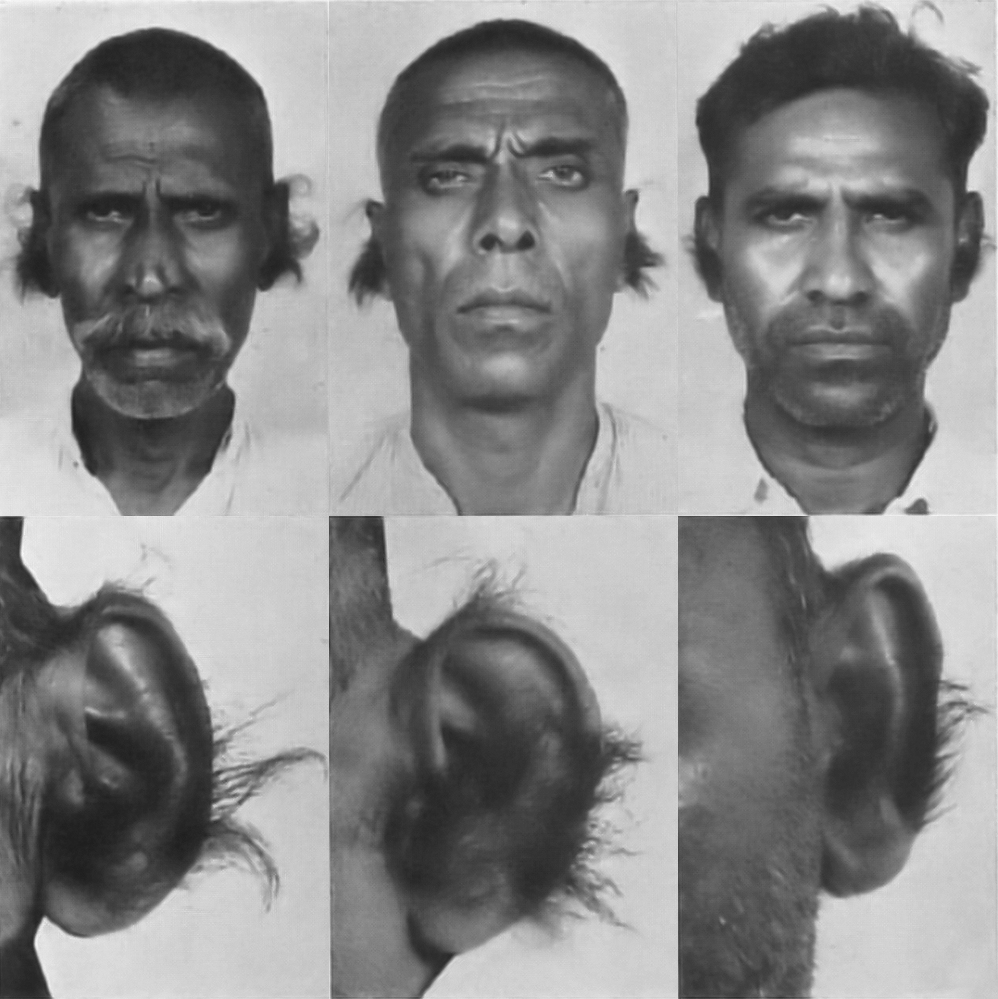
Hypertrichosis, or "Hairy
Ears": a Y-linked trait ? [ Not ] [OMIM
425500]
Growth of thick hair on the
pinnae of the external ears of males has long been
presented in genetics textbooks as a Y-linked trait, common in some south Indian
populations. The illustration shows three brothers. Molecular
population studies (Lee et al. 2004) indicate that men with hairy ears do
not share any common Y-chromosome
DNA sequences. Also,
frequencies of Y-chromosome
haplotypes shared among men with hairy ears are no different than
those in non-hairy control groups from the same population. The data thus indicate that
hairy-eared men are unrelated and do not share a common Y-linked allele. The trait may
instead be a sex-limited trait
(like beard growth) influenced by one or more autosomal loci (Carr
& Kasbekar, 2022).