Heritability of beak size in Darwin's Finch (Geospiza)
Heritability of beak size in Darwin's Finch (Geospiza)
Darwin's Finches
in the Galapagos islands include the Nutcracker Finch (Geospiza fortis), which has
evolved a deep bill that provides sufficient mechanical force to
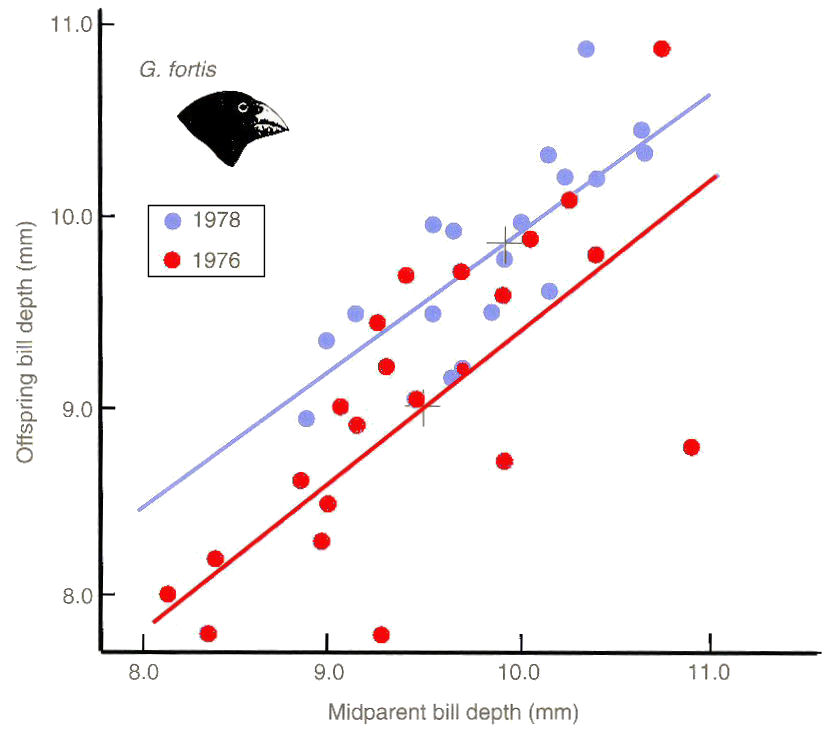
crack seeds. The graph shows the relationship between the bill depth of offspring
birds versus their
mid-parent value (the average of their two parents). One common measure of heritability
is the correlation between
parent
/ offspring measures. In 1976 (red
circles), the correlation was 0.90 (slope of red line), which
indicates a high degree of heritability.
A prolonged
drought from 1976 ~ 1978 produced
tougher seeds with lower water content. Only
finches with larger, deeper beaks that produced greater cracking
strength were able to survive. Heritability remained
constant in 1978
(the slope of blue line remains h
= 0.9, parallel to red line). However, beak measurements show the result of directional
natural selection: in 1978, no parental birds
with beak depth < 9mm survive (truncation of
the left end of the X-axis). Mean beak depth of
offspring birds has increased ~1.0 mm, as
measured by the difference between the midpoints of the two distributions
(the +
&
+ crosses).
These data show
several important aspects of on the concept of heritability.
Beak size has constant, high heritability (h = 0.9),
but beak size in any one year is highly variable (wide
range on the vertical Y-axis), and beak sizes varies
between years when the environment changes (displacement
of slopes on the Y-axis). Thus, high heritability
implies neither that a trait is invariant, nor
that it is constant.