The Ames Test for
mammalian
environmental mutagenicity
The AmesTest
combines a bacterial revertant mutation
assay
with a simulation of mammalian metabolism to produce a highly
sensitive
test for mutagenic chemicals in the environment.
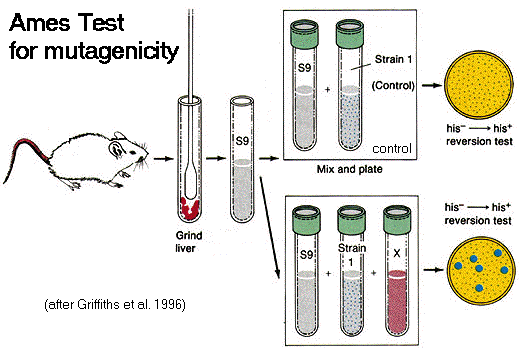
A rat liver homogenate
is prepared to produce a metabolically active extract (S9). [Above] The extract is
combined
with a strain of his-
Salmonella bacteria: in the absence
of
histidine, the bacteria
are
unable to grow on minimal
medium (control result). [Below] The homogenate and bacterial
strain
are combined with a suspected mutagenic substance (X). The
induction of revertant colonies
indicates that some his-
bacteria have mutated (reverted) to his+
, and therefore that substance X is a mutagen.
Different bacterial strains are sensitive to different types of mutation.
Initial experiments used the reversion assay
without
a liver homogenate. However, It is important to realize that
mutagenicity, unlike toxicity, is not the result of ingestion of a
suspect substance, but rather the accumulation of the substance
and its
breakdown products in the body. Use of a liver homogenate
simulates the metabolic breakdown of the suspected mutagen in a
mammalian system, and more accurately predicts mutagenicity of
substances ingested by humans. For example, sodium
nitrate (NaNO3), which occurs naturally in
smoked
meat such as bacon, hot dogs, ham, etc., is not itself mutagenic.
However, when acted upon by HCl
in
the
stomach,it
is converted to nitrous acid
(HNO2),
which
has
been demonstrated to be a powerful mutagen by the Ames Test.
Bruce Ames (1928 - ) and his
undergraduate
students tested large numbers of commercial products in student
labs at
UC Berkeley when the test was first introduced in the 1970s. Many
common items, such as
hairspray and
food colours, were discovered
to be
mutagenic and were withdrawn from the market. Ames also
established
that many mutagenic compounds are also carcinogenic, an
early indication that changes in DNA sequence led to cancer.
Illustration
after
Griffiths et al. © 1996; All text
material © 2014 by Steven M.
Carr