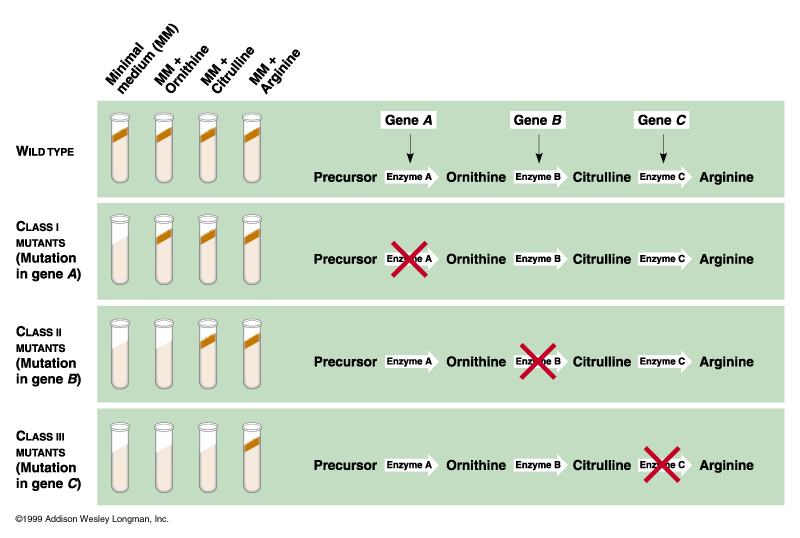
Consequences of mutations in the Arginine synthetic pathway in Neurospora
Synthesis of the amino acid arginine requires prior conversion of a precursor to ornithine, which is then converted to citrulline, which is then converted to arginine. Each of these three steps is under the control of a separate enzyme, coded for by a separate gene.
In wild type Neurospora, the synthetic pathway is intact, and spores are able to grow on minimal medium without added amino acids. In mutant Neurospora, some enzyme in the pathway is non-functional, so that spores are unable to grow on minimal medium. All of the mutants here are called arg- mutants, since in all cases supplementation of the minimal medium with arginine permits growth.
Among these
mutants,
three classes are
distinguishable, depending on their growth response to the
addition of
other amino acids in the pathway. Supplementation of the medium
with
any
amino acid downstream from an enzymatic block permits
growth,
since
the pathway is intact from that point on. For example, any of orn,
cit,
or arg permit growth of Class I mutants, since
only the
first
enzymatic step is blocked. Supplementation with an amino acid upstream
from the block will not permit growth, since the spores are
subsequently
unable to convert these precursors to arginine. For example,
neither orn
nor cit permit growth of Class III mutants, in
the
absence
of the final enzyme in the pathway. Then, the observation of Class
II
mutants, in which the addition of cit permits
growth and orn
does not, implies that cit occurs downstream and
orn
upstream from the block, that is, that orn
precedes cit
in the pathway.