 Adaptation
& Descent with Modification
as consequences of Natural Selection
Adaptation
& Descent with Modification
as consequences of Natural Selection
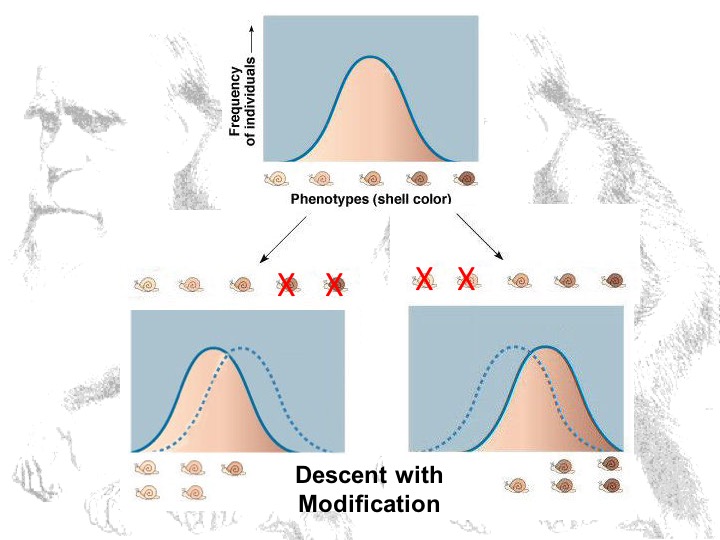
Consider a
species of snails that display a range of variation in shell color, from very light to very
dark. As in other snail species, shell phenotypes are largely due to genotype (heritability). Snails occur in a variety of
environments, including light sandy soils to dark forest
loams. Such environments vary over short distances (which may be
long distances for snails), for example between two backyards or
along a stream course.
The degree of match between shell
color and soil type confer an advantage from avian visual
predators. On lighter soils [left], light snails are
more cryptic and dark snails are preferentially eaten by birds. On darker soils
[right], the opposite is the case and darker snails are more
likely to survive.
The surviving individuals reproduce, in such a
way that population size remains constant. Each population now
shows better adaptation [is better adapted] to its
local circumstances, in that the character distribution of its
members is such that they are are on average more likely to survive and
reproduce than those in the preceding generation. Because
offspring resemble their parents, the next generation will have a
different character distribution than the preceding. Descent with
modification has occurred, such that each population has
greater fitness [is
more fit]. Further, the populations
have diverged from each
other: if continued indefinitely, the populations may over time
evolve into distinct species.
Figure
modified from the original; text material © 2021 by Steven M. Carr