Allele-Specific Oligonucleotide (ASO) test for Cystic Fibrosis
Allele-Specific Oligonucleotide (ASO) test for Cystic Fibrosis
Cystic
Fibrosis (CF) is an autosomal recessive disease, characterized by accumulation of mucous in the lungs.
The most common allele in
Europeans that leads to CF has a 3bp DNA deletion, and is
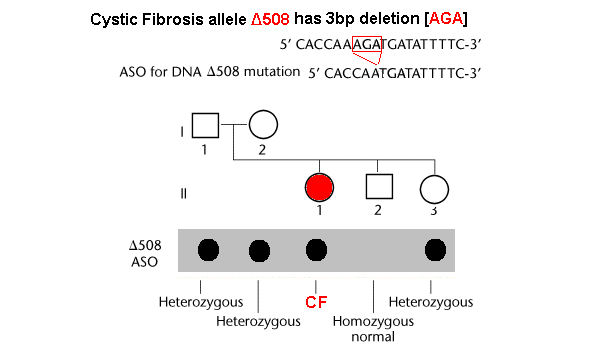
called  508. In the pedigree, the birth of an
affected daughter (II-1) to two unaffected parents
indicates that both are heterozygotes. The clinical question is
whether the two unaffected siblings are carriers for CF.
508. In the pedigree, the birth of an
affected daughter (II-1) to two unaffected parents
indicates that both are heterozygotes. The clinical question is
whether the two unaffected siblings are carriers for CF.
An
oligonucleotide probe is constructed with a sequence
complementary to the exact DNA
sequence of the allele with the 508 deletion: an allele-specific oligonucleotide
(ASO). DNA is obtained from all family
members and spotted onto a Southern hybridization
filter. The filter is probed with a radioactive ASO. Hybridization of
the ASO to the filter shows as
a spot on the autoradiogram,
which indicates the presence of the 508 allele. The molecular phenotypes of the
heterozygous parents and the affected daughter
are as predicted: each carries (at least) one 508 allele, and therefore tests positive. The unaffected son (II-2) tests negative
for the 508 allele and is therefore "homozygous standard",
whereas his unaffected sister (II-3)
tests positive for
508, and is therefore a "carrier" for CF.
Because the ASO method avoids
electrophoresis and size determinations, the tests are rapid and
suitable for large-scale population screens. The test as
described has two weaknesses as a diagnostic tool. First, about 30% of CF cases in persons of European ancestry are
due to alternative alleles
other than 508, and will not be detected with this specific
test. Second, the
hybridization test is subject to "false negatives": perhaps II-2 is a carrier,
but the ASO hybridization
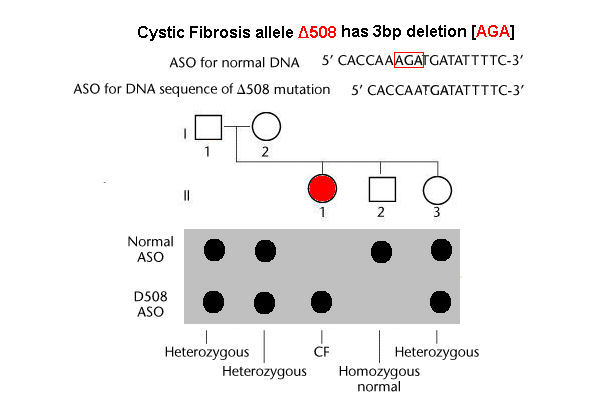
failed for technical reasons. The test can then be improved by
adding a parallel ASO "control"
test for the "standard" allele: