DNA Replication & Transcription
In principle: DNA replication is semi-conservative
H - bonds 'unzip', strands unwind,
complementary nucleotides added to existing
strands [iGen3
03-02]
After
replication, each double-helix has one "old" & one
"new" strand
[note alternative conservative & dispersive models: Homework #4 ] [iGen3 03-01]
DNA is not the
"Genetic Code" for proteins
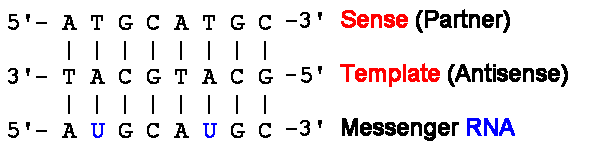
information in DNA must first be transcribed
into RNA
messenger
RNA
transcript is
base-complementary to template strand of DNA
& therefore co-linear with sense
strand of DNA
DNA & RNA syntheses occur only in
the 5'  3' direction
DNA synthesis in prokaryotes:
Nucleotides are added simultaneously to both strands, but
DNA grows in the 5' 3' direction ONLY [iGen3 03-03] [iG1 10.10]
Distinguish:
Replication:
duplication of a double-stranded
DNA (dsDNA) molecule
an exact 'copy' of the existing molecule (cf. xerox copy)
Synthesis:
biochemical creation of a new single-stranded DNA (ssdNA) molecule
a base-complementary 'copy' of an existing strand (cf. silly putty copy)
occurs only
in the 5' 3' direction
DNA
Synthesis in
prokaryotes [iGen3 03-04, -05,
-06]
(1) Formation of replication fork at Origin of Replication
[iG1 10.16, 19]
provides two single-stranded DNA template (ssDNA)
multiple replications forks (replicons) [iGen3 03-09]
(2) Synthesis of RNA primer [iG1 10.15]
(3) Addition of dNTPs by DNAPol III
at 3'
end only
continuous synthesis on leading strand [iG1 10.13]
(4)
discontinuous
synthesis on lagging strand [iG1 10.20]
Okazaki fragments
proof-reading by 3'5' exonuclease activity [iG1 10.12]
leading & lagging strand
synthesis simultaneously [iGen3 03-08]
[iG1 10.21]
A single, dimeric DNAPol III replicates
both
strands
(5) Excision of RNA
primer by DNAPol I
ligation (connection)
of fragment ends at gaps by DNA
ligase [ [iG1 10.22]
A talkie animation of
DNA synthesis `[onlineMGA2
animation]
DNA synthesis in eukaryotes
Eukaryotic
genomes are much larger [the "C-value Paradox"]
 eukaryotic DNA synthesis
is more efficient:
eukaryotic DNA synthesis
is more efficient:
More DNAPol molecules,
slower rate of synthesis, more replicons,
E.
coli: 15 DNAPol add 100,000
bases/min over 3,500
replicons
4.2 x 10⁶
bp genome replicated in 20
~ 40 min
Drosophila: 50,000 DNAPol add 500
~ 5,000 bases/min
over 25,000 replicons
330 x 106 bp diploid genome replicated in
< 3 min : net 600x faster
Transcription: synthesis of messenger RNA (mRNA) (online
MGA2 animation)
What is a "Gene" [iGen3
05-03]
RNA transcribed from DNA by RNA Polymerase (RNAPol I) [iGen3
05-01] [iG1 4.17]
(1) Recognition of transcriptional unit: ~ 'gene'
[iG1 4.18]
Promoters - short DNA sequences
that regulate transcription
typically 'upstream'
= ' leftward' from 5' end of sense strand [iG1
4.12]
(2) Initiation & Elongation [iGen3
05-04ab , -04cd]
[iG1 4.22,
23, 24]
mRNA synthesized 5'3' from DNA template strand
mRNA sequence therefore homologous to DNA sense strand
Colinear: mRNA and DNA
sense strand "line up"
(in
prokaryotes, but not eukaryotes:
see below)
Process similar to DNA replication [iG1 4.25], except
No primer is required
Transcription may occur from either strand
Most DNA is not
transcribed into RNA
(3) Termination
[iGen3
05-05] [iG1
4.27, 28, 29]
Regulation of
transcription
In
prokaryotes, transcription &
translation may occur simultaneously
In eukaryotes,
transcription occurs in nucleus [ex.: Lampbrush chromosomes]
translation
occurs in cytoplasm (see next section):
RNA must cross nuclear
membrane
[iGen3
05-09]
transcription
& translation are physically separated
primary RNA
transcript is extensively processed
heterogeneous
nuclear RNA (hnRNA) mRNA
Post-transcriptional processing of eukaryotic RNA
is complex [iG1 4.9]
promoters [iG1 4.19]
& enhancers [iG1 ] determine initiation & control rate
'cap' (7-methyl guanosine, 7mG) added to 5'
end [iGen3 05-10]
[iG1 4.26]
'tail' of poly-A (5'-~~~AAAAAAAAAA-3')
added to 3' end [iGen3
05-11] [iG1 4.33]
'splicing' of hnRNA : eukaryotic genes are "split" [iGen3 05-12]
intron DNA sequence
equivalents removed from hnRNA : "intervening"
[iGen3 05-14]
exon DNA
sequence equivalents represented
in mRNA: "expressed"
in protein
1 ~ 12's of exons /
'gene'
>90% of transcript may be 'spliced
out'
[An
important note on terminology]
Splicing mechanism uses donor and acceptor sites
[iG1 5.18, 19, 20]
Eukaryotic genes & mRNA are not colinear!
DNA / RNA hybridization
produces heteroduplexes
DNA
introns 'loop out'
DNA exons pair with mRNA
Eukaryotic exons may be widely
separated
Alternative splicing of the same transcript produces
different products [iG1 4.16]
Different exon regions
are combined as different mRNAs [iG1 5.01]
Alternative exon
combinations differ functionally [iG1
5.22]
Summaries
of transcription [& translation] in prokaryotes
& eukaryotes
Homework #5:
Suggested problems from
Solved problems 1 & 2
problem ## 7, 8, 9, 11, 14, 15 , 18, 19, 21, 26, 27
for
extra
fun:
##
29
&
34
iGen3 (2010), Chapter 5, pp. 98-101
Problems ## 2, 4, 6, 7,
12, 13, 15, 16, 21
IG1 (2012) - TBA
Ongoing Homework problem:
What is a 'gene'?
How do the discoveries of (1) introns and exons
amd (2) alternative splicing in eukaryotic
genomes modify the concept?